
Forklift Pedestrian Safety System Basics -test
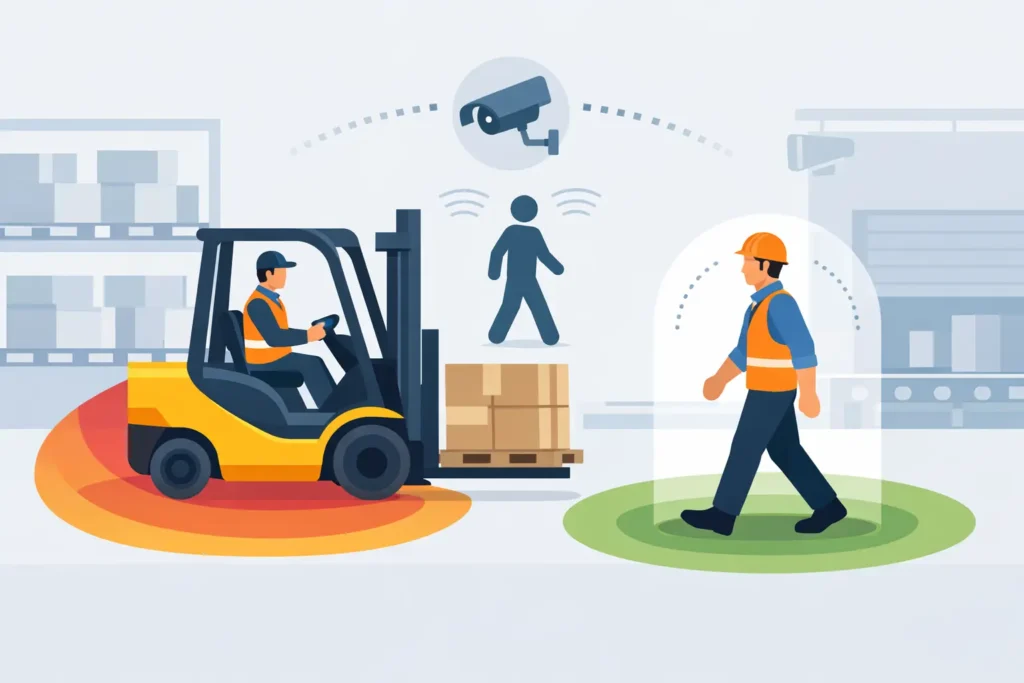
A near miss at a warehouse intersection rarely stays a near miss forever. When forklifts and pedestrians share the same space, one blind corner, one rushed turn, or one missed warning can lead to a serious injury, damaged stock, and disrupted operations. A forklift pedestrian safety system is designed to break that chain before contact happens. For warehouse managers, EHS teams, and plant leaders, this is not just about adding another device to the site. It is about controlling one of the most persistent risks in material handling environments – vehicle-to-person interaction. The right system helps create earlier awareness, clearer movement rules, and more time for both drivers and pedestrians to react. Why forklift and pedestrian interaction stays high risk Forklift accidents are rarely caused by one failure alone. More often, they happen when normal operational pressures stack up. Traffic volume increases during peak periods. Pedestrians take shortcuts across travel lanes. Operators handle loads that limit forward visibility. Ambient noise makes horns less effective. Familiarity with the site creates overconfidence. That combination is why painted walkways and basic safety signage, while still necessary, are often not enough on their own. Static controls depend heavily on constant human attention. In active facilities, attention is exactly what gets stretched. A forklift pedestrian safety system adds an active layer of protection. Instead of relying only on rules people are expected to remember, the system helps identify movement, trigger alerts, and reinforce separation where risk is highest. That shift matters because prevention works best when it is built into the environment, not left solely to behavior. What a forklift pedestrian safety system actually does At its core, a forklift pedestrian safety system reduces the likelihood of a person and a moving truck occupying the same dangerous space at the same time. Different systems do this in different ways, but the goal is consistent – detect risk early and create a clear warning or intervention. In practical terms, this can include visual alerts at crossings, projected warning zones around forklifts, sensor-based detection at blind corners, audible warnings in mixed-traffic areas, or intelligent systems that recognize pedestrian presence and trigger location-specific alerts. In more advanced environments, safety controls may be integrated across forklifts, access points, barriers, and AI-enabled monitoring. The best systems do not replace site rules. They strengthen them. If your traffic plan says pedestrians should stop before entering an aisle crossing, the system reinforces that behavior with lights, sound, or detection-based warnings. If your risk assessment identifies a blind rack end as a recurring hazard, the system turns that point into an actively managed safety zone. Where these systems deliver the most value Not every area in a facility carries the same level of risk. The highest return usually comes from targeted deployment in places where visibility, speed, and foot traffic overlap. Blind intersections and cross aisles These are among the most common conflict points. A pedestrian may step into an aisle without seeing an approaching truck, while the operator may be focused on load stability or an obstructed line of sight. Warning lights, motion sensors, and corner alerts can give both parties a few critical seconds of awareness. Picking zones and staging areas In fast-moving warehouses, pedestrians often work close to forklift routes during replenishment and order preparation. Even when traffic lanes are marked, workflow pressure can erode separation. Active warning systems help maintain awareness when routine movement becomes unpredictable. Loading and unloading approaches Dock areas combine forklifts, pallet jacks, trucks, and foot traffic in a compressed space. The risk is not only collision but also sudden directional changes, reversing, and congestion. Here, a forklift pedestrian safety system can support better movement control and reduce confusion during busy loading windows. Manufacturing plants with mixed traffic Production sites often have less predictable pedestrian behavior than highly structured warehouses. Maintenance staff, supervisors, contractors, and operators may enter vehicle zones for different reasons throughout the day. In these settings, technology-backed alerts can support compliance where physical segregation is incomplete. Choosing the right forklift pedestrian safety system There is no single best system for every site. The right choice depends on traffic flow, layout constraints, operating speed, workforce behavior, and risk tolerance. A facility with a few clearly defined blind corners may benefit from localized warning solutions. A large distribution center with high traffic density may need a more layered approach that combines forklift-mounted alerts, pedestrian detection, visual signaling, and physical separation. A plant with frequent layout changes may prioritize flexible systems that can be adapted as operations evolve. This is where many projects go wrong. Buyers sometimes focus on product features before defining the operational problem. A louder alarm is not necessarily safer if background noise is already high. A sophisticated detection platform may be excessive for a simple, low-traffic crossing. At the same time, a low-cost standalone device may not be sufficient for a site with repeated near misses across multiple zones. A good assessment starts with a few practical questions. Where do forklifts and pedestrians meet most often? Where are visibility limitations worst? What incidents or near misses have already occurred? Which controls depend too much on perfect human behavior? When those answers are clear, system selection becomes more defensible and more effective. Technology matters, but implementation matters more A forklift pedestrian safety system only performs as well as its installation logic, calibration, and fit with real operations. This is why engineering support matters. For example, detection zones that are too wide can create alarm fatigue. If alerts trigger constantly in low-risk situations, people stop responding. Detection zones that are too narrow may activate too late to be useful. Audible alarms that are clear in one part of a facility may be drowned out near conveyors or dock equipment. Visual warnings need to be positioned for actual sight lines, not ideal ones on a layout drawing. That is also why pilot deployment can be valuable. Testing a system in one problem area often reveals practical adjustments before wider rollout. The goal is not