
A near-miss at a warehouse crossing rarely looks dramatic on paper. A forklift brakes late, a picker steps out from behind racking, and both keep moving. No injury, no damaged pallet, no shutdown. But for safety and operations leaders, that moment is the real test. A warehouse safety compliance guide should help you catch those failures before they become recordable incidents, equipment damage, or lost production time.
Compliance in a warehouse is not just about having procedures filed away or floor markings that looked clear on day one. It is about whether your controls still work when visibility is blocked, shift pressure increases, and traffic patterns change. The best compliance programs are built around real operating conditions, not ideal ones.
What warehouse safety compliance actually means
In practice, warehouse safety compliance means your operation can identify hazards, assess risk, apply controls, train people, and verify that those controls remain effective over time. That sounds straightforward. The challenge is that warehouses are dynamic environments. Inventory changes, temporary staff rotate in, forklifts move faster during peak periods, and loading bays see different vehicle types throughout the week.
That is why compliance should be treated as an operating discipline rather than a one-time audit exercise. A documented risk assessment matters, but it matters more when it leads to clear traffic routes, protected pedestrian zones, controlled dock activity, and early warning systems that workers actually notice and trust.
For most facilities, the highest-risk areas are also the most routine. Forklift travel lanes, blind intersections, rack end impacts, trailer movement at loading bays, and mixed-use spaces where pedestrians and vehicles share the same footprint tend to generate repeated exposure. If your team sees these as normal friction points, your risk level is already higher than it appears.
Start this warehouse safety compliance guide with exposure, not paperwork
Many compliance gaps begin with a simple mistake. Teams start by checking documents rather than checking where risk concentrates. Paperwork matters, but exposure mapping gives you the right priorities.
Begin with traffic flow. Look at where forklifts travel, where pedestrians cross, where goods are staged, and where operators reverse or turn with limited sightlines. Then review how those patterns change by shift, by season, and during delivery peaks. A route that is safe at 10 a.m. may become hazardous at 4 p.m. when pallets accumulate near dispatch.
Next, assess loading bay activity. This area often combines vehicle movement, time pressure, uneven surfaces, and communication gaps between drivers and warehouse teams. If your dock controls rely too heavily on manual coordination, there is a greater chance of premature vehicle departure, unsafe trailer access, or pedestrian exposure around active bays.
Then look upward and outward. Rack protection, barrier placement, and aisle edge controls are often treated as damage prevention measures, but they are also compliance controls. Repeated rack strikes or impact damage around structural elements signal that your traffic management plan is not fully working.
The controls that make the biggest difference
The most effective warehouse compliance programs do not depend on a single control. They combine physical separation, visibility improvement, behavior reinforcement, and ongoing monitoring.
Physical segregation is still one of the strongest controls in a live warehouse. Barriers, guardrails, and designated pedestrian routes reduce reliance on human judgment in high-traffic zones. This is especially important in facilities where contractors, visitors, or new staff may not fully understand local vehicle patterns.
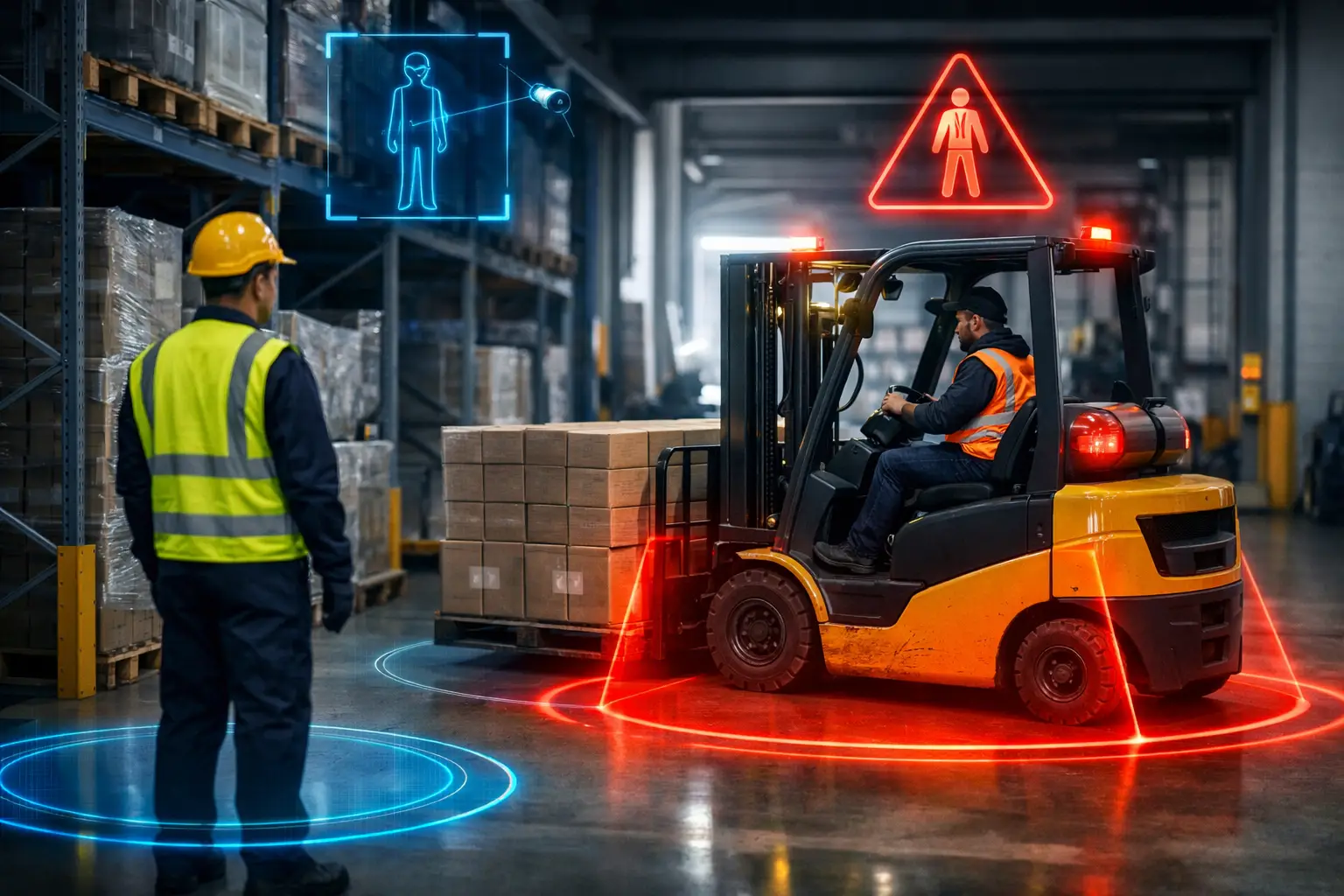
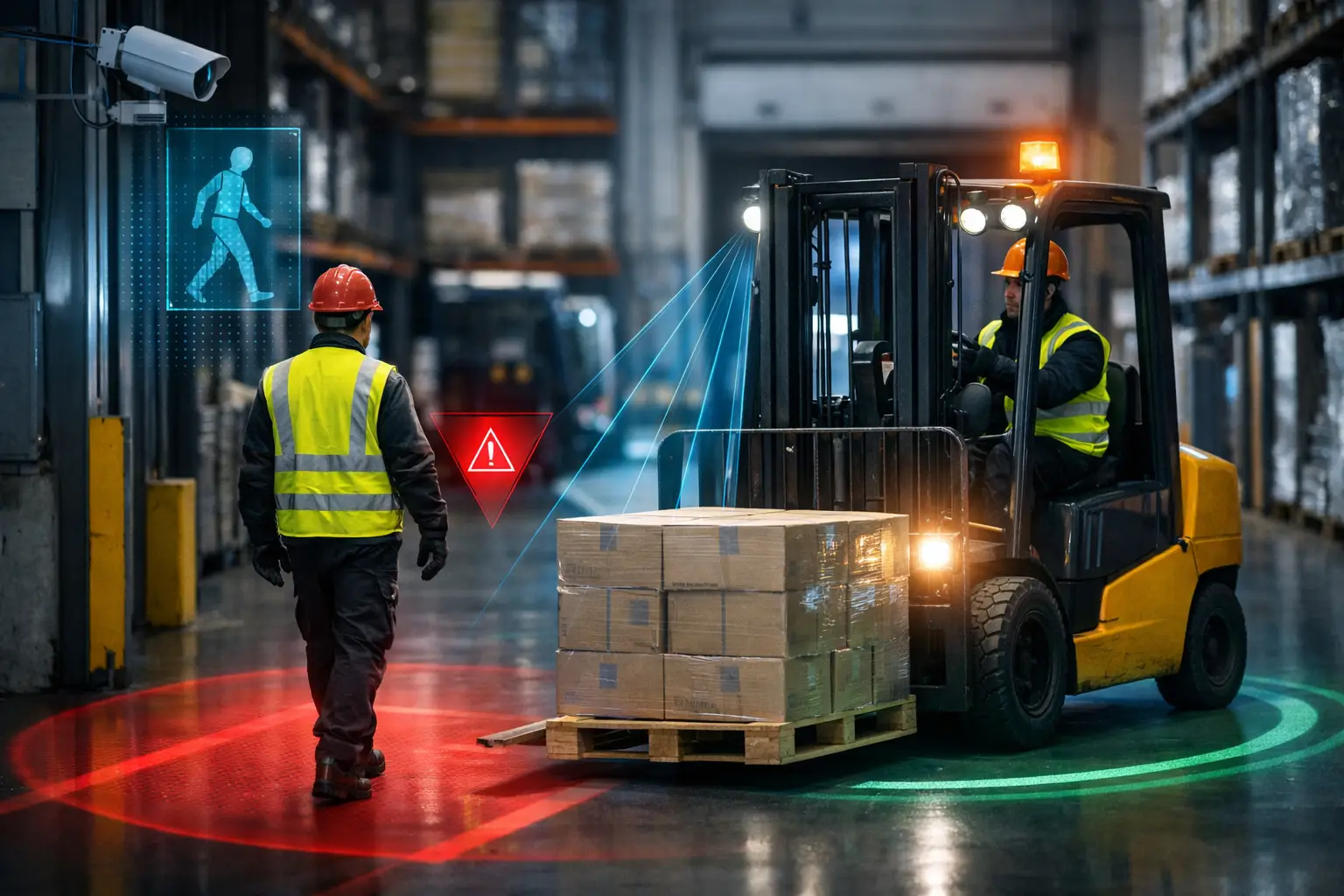
Visibility controls come next. Blind corners, rack end crossings, and loading bay approaches create conditions where people and vehicles meet too late. Safety floor projection, warning lights, audible alerts, and proximity warning systems can improve reaction time, but placement matters. If alerts are too frequent or poorly aimed, workers begin to ignore them. Effective warning systems are calibrated to the environment and tied to actual risk points.
Forklift-pedestrian collision prevention deserves special attention because it sits at the center of many warehouse incidents. Training operators is necessary, but training alone cannot overcome blocked sightlines, congested lanes, or unpredictable foot traffic. In higher-risk environments, technology-based controls such as intelligent alerts or AI-assisted monitoring can strengthen awareness and support better behavior without depending solely on memory and discipline.
Loading bay protection is another area where compliance and operational continuity meet directly. Vehicle restraint systems, dock safety indicators, and controlled access measures help prevent unsafe loading conditions and reduce the chance of trailer movement during transfer. These controls also support smoother dock operations by making status visible and reducing uncertainty.
Why training alone does not close the gap
Most warehouse leaders already know this from experience. You can run toolbox talks, issue reminders, and refresh SOPs, yet still see the same near-misses in the same locations.
That is not because training has no value. It is because training works best when the workplace reinforces the right behavior. If pedestrians routinely take shortcuts across vehicle lanes because the designated path is too long or obstructed, the site is teaching the wrong lesson. If operators approach blind intersections without advance warning, they are being asked to compensate for a design problem.
A practical warehouse safety compliance guide has to address this gap honestly. The question is not whether your people know the rule. The question is whether the environment makes the safe action the easiest action.
Use data to verify control effectiveness
Warehouse safety can become subjective very quickly. One supervisor says an area is under control because no incident has been reported. Another says the same area feels unsafe during peak activity. Both views are incomplete.
Verification requires data. Near-miss reporting is one source, but it is not enough on its own because underreporting is common in busy operations. Equipment impact records, rack repair frequency, congestion timing, forklift route deviations, and recurring dock delays often reveal more about weak controls than injury statistics do.
This is where monitoring technology can add operational value. Vision AI safety monitoring and connected warning systems can help identify repeated exposure points, unsafe behaviors, and timing patterns that are easy to miss during manual observation. The goal is not surveillance for its own sake. It is to give managers better evidence for decisions about layout changes, barrier placement, traffic controls, and training priorities.
There is a trade-off here. More data does not automatically mean better safety. If a site installs technology without defining what actions will follow, the system becomes noise. Data only improves compliance when someone owns the response.
Build compliance into daily operations
A strong compliance program is visible in routine management, not just during audits. Supervisors should know which intersections generate the most exposure, which dock positions create recurring risk, and which aisles see frequent encroachment into pedestrian space. Engineering and maintenance teams should also be involved because damaged barriers, faded markings, failed alert devices, and misaligned sensors quickly weaken otherwise sound controls.
This is also where many multi-site organizations struggle. One facility may maintain excellent traffic discipline while another relies on local habits that developed over time. Standardization helps, but only if it leaves room for site-specific risk. A distribution center with intensive forklift turnover needs different control density than a lower-traffic storage site.
For operations across markets such as Singapore, Malaysia, and Indonesia, this practical approach matters even more. Facility layouts, workforce mix, traffic intensity, and enforcement expectations can vary. The common requirement is not identical equipment in every building. It is a consistent method for identifying risk, applying controls, and checking performance.
A practical way to review your warehouse safety compliance guide
If your current program feels mature on paper but uneven on the floor, review it against five simple questions. Are pedestrian and vehicle flows physically separated where exposure is highest? Are blind spots and crossings supported by effective visual or audible warnings? Are loading bays protected by controls that reduce movement risk during transfer? Are repeated impacts or near-misses tracked as control failures rather than accepted as normal? And does the site use real operating data to improve layout, technology, and procedures over time?
If the answer to any of those questions is inconsistent, that is where improvement should begin. Not with broad messaging, and not with more documentation than the site can maintain. Start where exposure is concentrated and where the right intervention can remove risk from daily work.
Every worker deserves to return home safely every day. In a warehouse, that outcome depends less on what your compliance file says and more on what your controls do when the floor gets busy.