A forklift incident rarely starts with a dramatic mistake. More often, it starts with something routine – a rushed turn at the end of an aisle, a blocked sightline near a dock door, a pedestrian stepping into a travel path, or an operator using equipment that should have been taken out of service. That is why knowing how to prevent forklift accidents is not just a training issue. It is an operational discipline that affects people, equipment, uptime, and the resilience of the entire facility.
In warehouses, plants, and logistics sites, forklifts move where pressure exists. Orders are backing up, trucks are waiting, production cannot stop, and teams are trying to keep throughput on target. The challenge is not simply telling operators to be careful. The real challenge is designing an environment where safe behavior is supported by traffic rules, clear visibility, protective systems, and management follow-through.
How to prevent forklift accidents starts with risk visibility
Most facilities already know their broad risks. They know forklifts and pedestrians share space. They know loading areas are hazardous. They know reversing, turning, and crossing intersections create exposure. Yet accidents still happen because risk is often understood in general terms instead of mapped to specific behaviors and locations.
A stronger starting point is to identify where incidents are most likely to occur. That usually includes aisle intersections, dock approaches, staging zones, blind corners, battery charging areas, trailer entry points, and any place where foot traffic overlaps with vehicle routes. Near-miss reporting matters here because it reveals patterns before injuries or major damage occur. If operators repeatedly brake hard at the same crossing or if pedestrians regularly cut through a travel lane, the site is telling you where controls are weak.
This is also where many safety programs either improve quickly or stall out. If the response is only procedural, results tend to be limited. If the response includes physical and technological controls, risk reduction becomes more consistent.
Operator training is necessary, but it is not enough
Every facility needs trained and authorized operators. That part is non-negotiable. Operators should understand load capacity, stability, speed control, turning radius, braking distance, visibility limits, and safe parking practices. They also need site-specific instruction, because one of the most common failures in forklift safety is assuming that general certification alone prepares someone for every layout and every workflow.
Still, training has limits. Even good operators make errors when they are fatigued, rushed, distracted, or dealing with unpredictable traffic. This is why the best safety programs do not place the full burden on individual performance. They build layers of protection around the operator.
Refresher training should be driven by real conditions, not a calendar alone. After near misses, layout changes, equipment changes, seasonal labor increases, or process shifts, teams should reassess whether operators are working in a different risk profile than before. A facility that has added more pedestrian movement, tighter staging, or higher truck volumes may need to retrain for those realities.
Separate people and forklifts wherever possible
If you want a practical answer to how to prevent forklift accidents, start by reducing interaction between pedestrians and moving equipment. The fewer shared spaces you have, the lower your exposure.
That can mean designated walkways, physical barriers, controlled crossing points, and access restrictions around high-traffic zones. Painted lines help, but they are not enough in high-risk areas. In active operations, people under pressure do not always respect visual markings, especially when shortcuts save time. Physical separation creates a stronger control because it does not depend solely on human judgment in the moment.
There is a trade-off, of course. More barriers and tighter route control can affect workflow flexibility. But this is where engineering judgment matters. The goal is not to overbuild the site. It is to protect the areas where conflict is most likely and consequences are most severe.
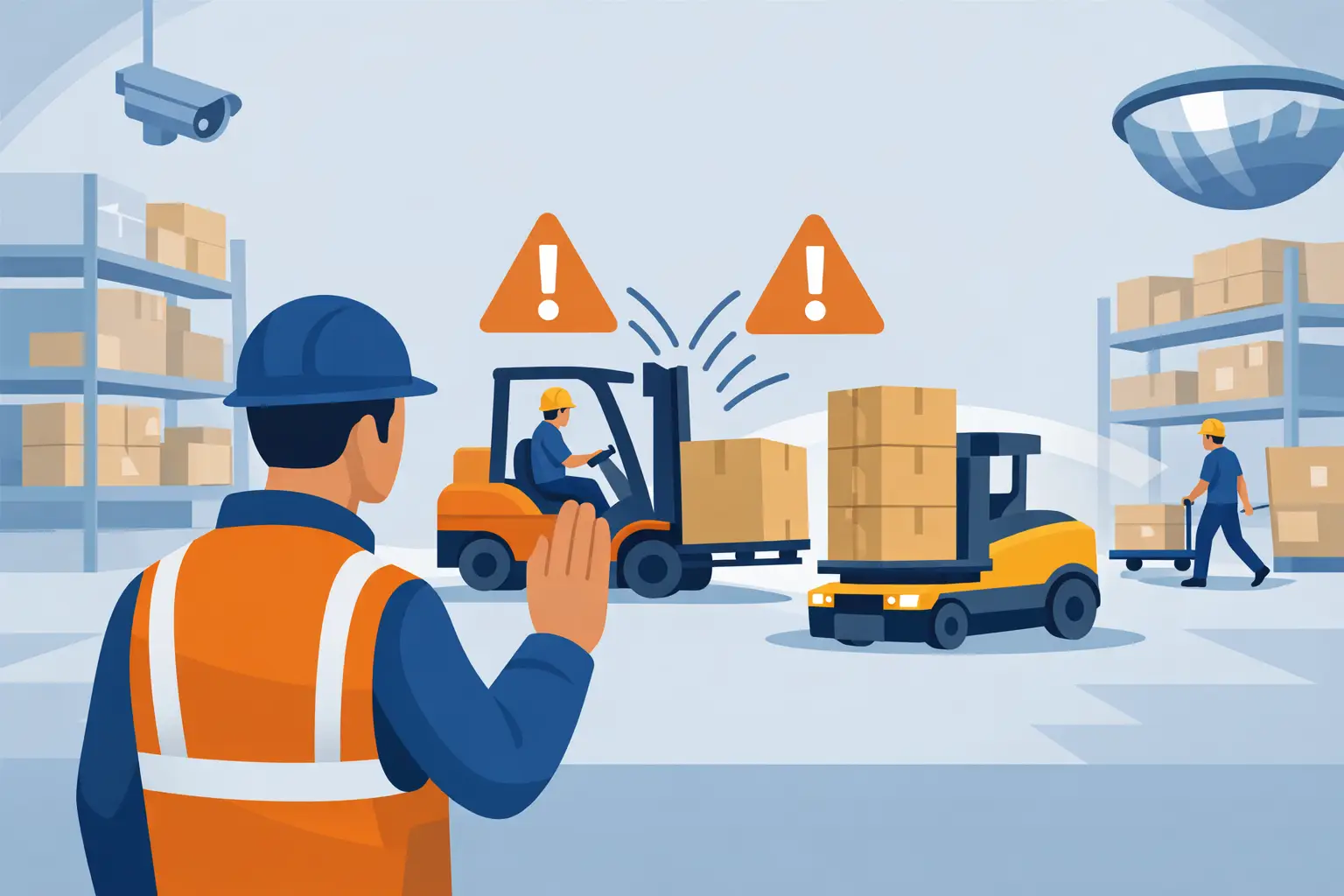
For many operations, intersections deserve special attention. These are common points of impact because both operator and pedestrian visibility can be compromised. Audible and visual warnings, controlled right-of-way rules, convex mirrors where appropriate, and speed management all help. In higher-risk environments, sensor-based alerts and AI-supported detection can add another layer by identifying movement before a collision occurs.
Control speed, sightlines, and right-of-way
Many forklift accidents are not caused by extreme speed. They are caused by speed that is inappropriate for the space, load, and visibility conditions. A forklift moving at what seems like a reasonable pace can still be unsafe if it is approaching a blind corner, carrying a tall load, or entering a congested dock area.
Speed limits should reflect actual risk by zone. Open travel lanes may justify one standard, while pedestrian crossings, dock approaches, and intersections require another. Just as important, facilities need a way to reinforce those limits. Signage alone has weak staying power if supervisors do not monitor compliance and if the site layout encourages fast travel.
Sightlines matter just as much. Storage overflow, poor rack placement, stacked pallets, parked equipment, and temporary staging can all create blind spots. Housekeeping and layout discipline are safety controls, not administrative details. If an operator cannot see clearly, the operation has already accepted unnecessary risk.
Right-of-way rules should also be simple enough to apply under pressure. Confusing traffic rules create hesitation, and hesitation in shared spaces can be dangerous. Operators, pedestrians, and visiting drivers should all understand who stops, where crossings are allowed, and how hazardous zones are signaled.
Equipment condition directly affects accident risk
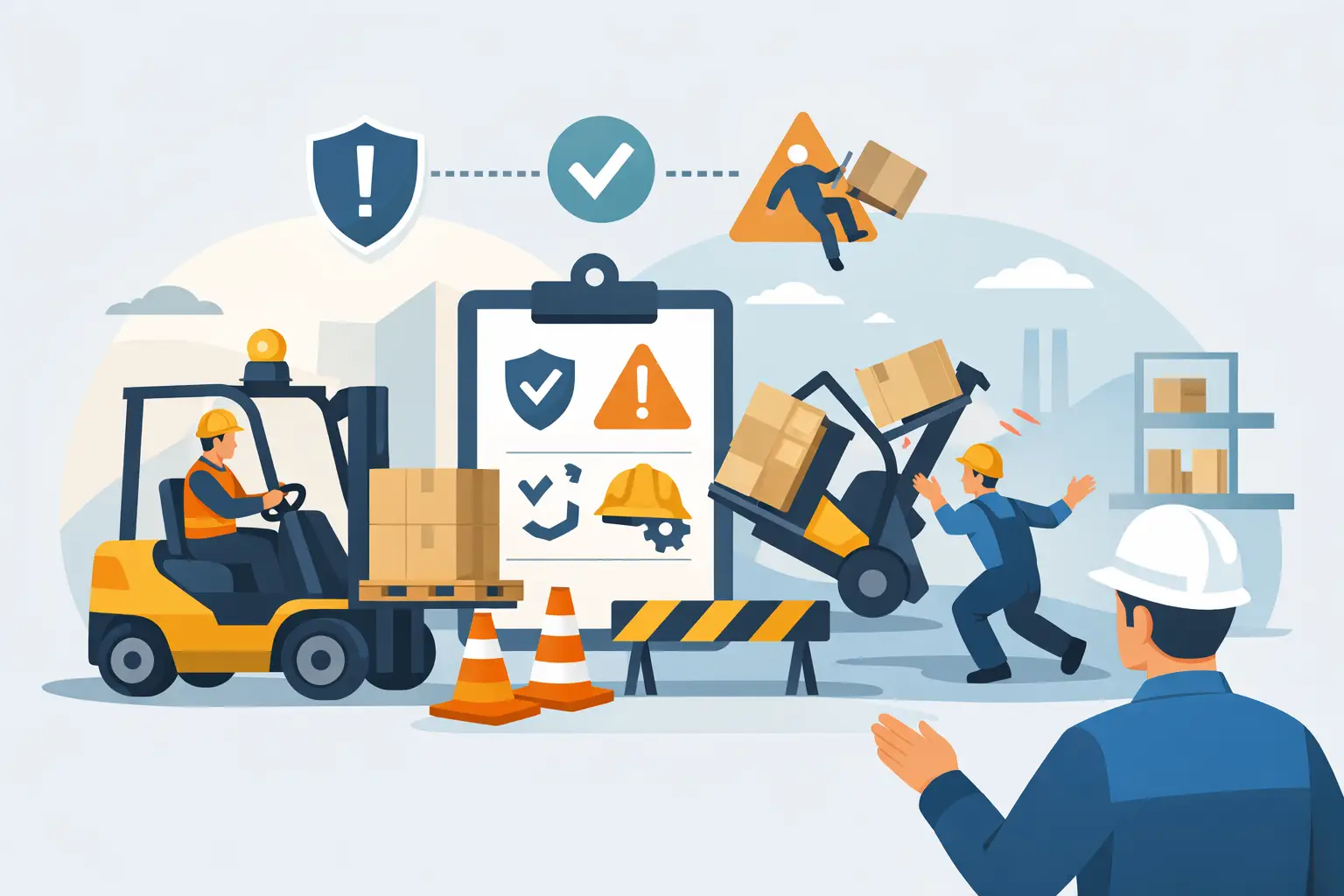
A forklift with worn tires, weak brakes, faulty lights, inconsistent steering, or a damaged horn is not just a maintenance issue. It is a live safety exposure. Daily pre-use inspections are essential, but their value depends on follow-through. If defects are logged and equipment remains in circulation, the inspection process becomes paperwork instead of protection.
Facilities should make it easy for operators to report issues and just as easy for supervisors to remove equipment from service. This sounds straightforward, but operations often resist pulling a truck offline when demand is high. That is a short-term decision with long-term consequences. One avoidable collision can create injury costs, infrastructure damage, downtime, and reputational impact that far exceed the cost of temporary equipment disruption.
Preventive maintenance should focus on the components that affect stopping, steering, warning, stability, and visibility. It should also account for the actual duty cycle of the equipment. A forklift running intensive multi-shift operations will not age the same way as one used intermittently. Safety planning works better when maintenance schedules reflect real operating conditions rather than fixed assumptions.
Loading docks and transition zones need extra protection
Some of the most serious forklift incidents happen where environments change quickly – at loading docks, trailer entry points, ramps, and threshold areas between warehouse and transport activity. Surface changes, edge hazards, trailer movement, poor lighting, and compressed timing all increase risk.
These areas benefit from more than operator caution. Facilities should look at dock safety systems, vehicle restraint practices, impact protection, warning systems, and traffic sequencing. The objective is to reduce uncertainty. If an operator is unsure whether a trailer is secure, whether a dock is occupied, or whether another vehicle is approaching, the site is relying too heavily on assumption.
This is one reason many industrial operators are moving toward integrated safety systems rather than isolated controls. A warning light, barrier, sensor, or restraint is more effective when it supports a clear operating rule and a defined traffic flow.
Technology can close the gap between policy and behavior
Procedures are necessary, but they do not always hold up in fast-moving environments. Technology helps by making hazards more visible and responses more immediate.
Depending on the facility, that can include pedestrian detection, proximity alerts, audible and visual warning systems, impact protection barriers, rack protection, and vision-based monitoring in conflict zones. The right mix depends on the site. A narrow-aisle warehouse with heavy foot traffic has different needs than a manufacturing plant with dock-intensive movement.
The key is not adding technology for its own sake. It is choosing controls that address recurring failure points. If near misses happen at blind crossings, focus there. If damage is frequent around rack ends and structural assets, protect those areas. If pedestrian exposure is the main concern, prioritize separation and active warning systems.
For companies that want a more systematic approach, a consultative safety assessment can help turn scattered concerns into an engineered plan. That is often where the greatest gains happen, because the solution becomes site-specific rather than generic.
Leadership sets the real safety standard
A facility can have written rules, trained operators, and marked walkways, yet still struggle if production pressure consistently overrides safe practice. Workers notice what leadership tolerates. If speeding is ignored during peak periods or damaged barriers are left unaddressed, the message is clear.
Preventing forklift accidents requires visible management commitment. That means enforcing route rules, acting on inspection findings, reviewing near misses, funding physical improvements, and treating safety controls as operational infrastructure rather than optional extras. It also means recognizing that accident prevention supports continuity. Protecting workers, equipment, and facility assets reduces disruption and strengthens day-to-day performance.
For many organizations, the most effective shift is moving from reactive correction to designed prevention. That is where experienced safety partners such as SysGuard can add value – not by replacing internal ownership, but by helping operations build practical systems that hold up under real industrial conditions.
Every worker deserves to return home safely every day. The facilities that make that happen are not relying on luck or reminders alone. They are building environments where safe forklift operation is expected, supported, and engineered into the work itself.