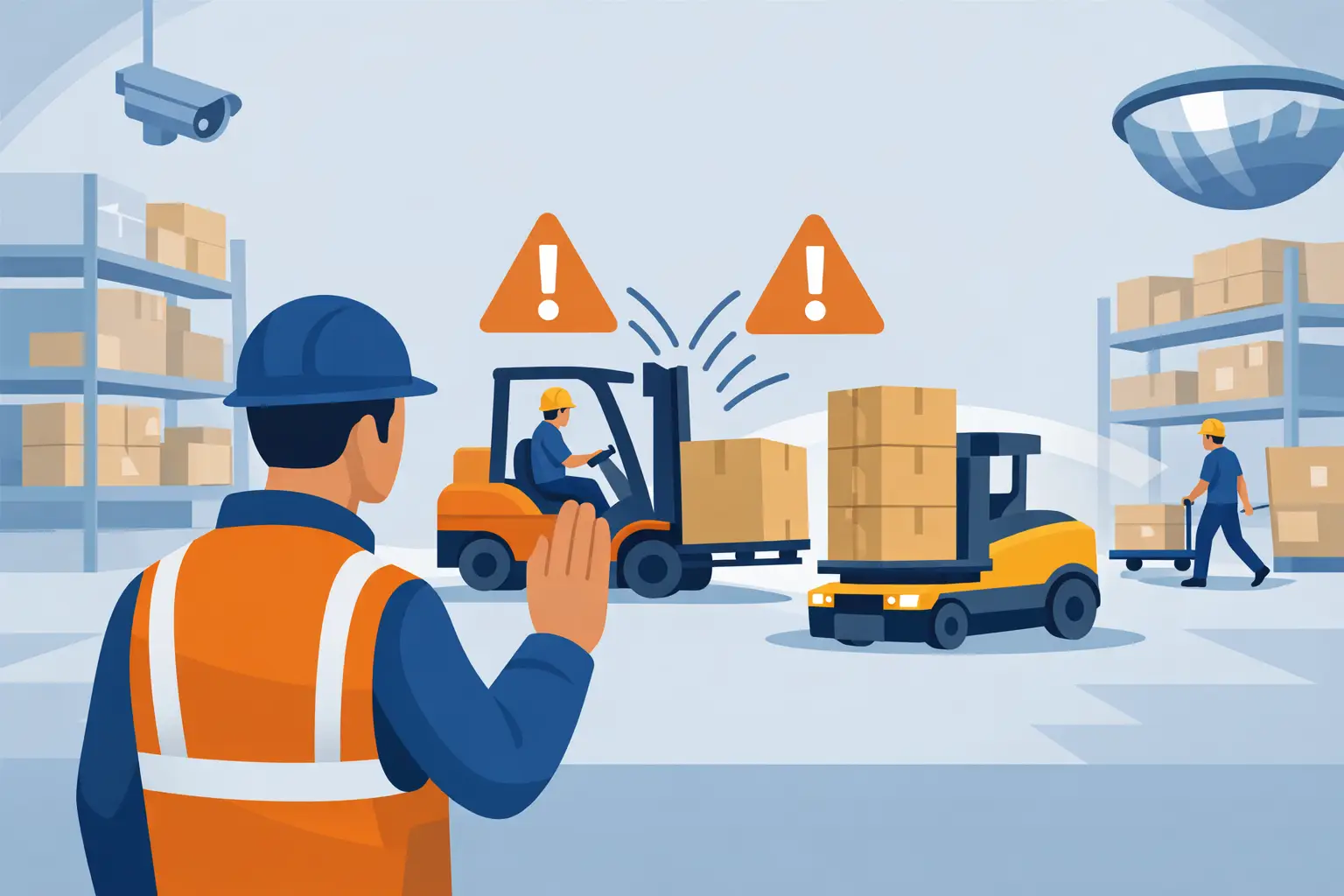
A near miss at a blind aisle crossing rarely looks dramatic. A forklift appears, a pedestrian steps forward, both stop short, and work continues. But that split second tells you something important: your facility is relying too heavily on luck. A warehouse warning light system adds a visible, immediate layer of control where people, vehicles, and infrastructure interact under pressure.
For warehouse managers, EHS teams, and operations leaders, that matters because many incidents are not caused by a lack of rules. They happen because visibility is poor, noise masks alarms, and busy operators make decisions in fractions of a second. Warning lights do not replace training, traffic planning, or physical barriers. They strengthen all three by making hazards harder to miss in the exact places where risk is highest.
What a warehouse warning light system actually does
At its core, a warehouse warning light system uses visual signals to alert workers and drivers to live hazards. That may sound simple, but in an active material handling environment, timing and placement make all the difference. A well-designed system warns a forklift driver before entering a blind intersection, alerts pedestrians near a high-traffic crossing, and signals danger at loading bays where trailer movement and vehicle approach create serious exposure.
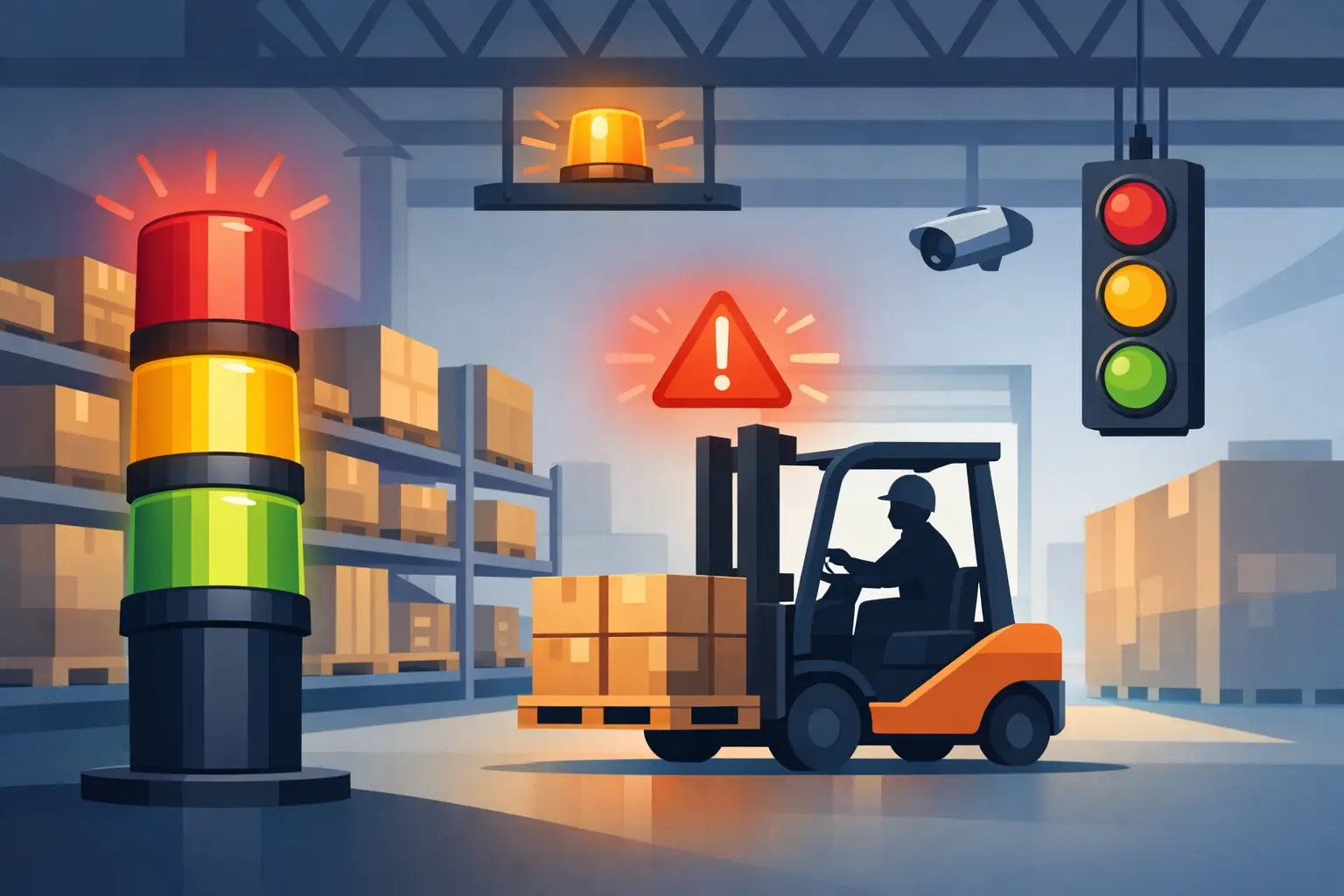
These systems can include flashing beacons, projected safety lines, motion-activated alerts, traffic lights, dock status indicators, and integrated audible signals. Some operate as standalone devices. Others are tied into sensors, doors, dock equipment, forklift movement, or site-wide control systems.
The real value is not the light itself. It is the decision it triggers. Stop. Wait. Check. Reroute. That brief intervention can prevent injury, rack damage, vehicle impact, and lost operating time.
Where warehouse warning light systems deliver the most value
Not every area in a facility carries the same risk. The best results come from targeting locations where vehicle movement is frequent, sightlines are limited, and people and equipment share space.
Blind corners and aisle intersections
This is one of the most common use cases. Racking, stacked goods, and building columns can block visibility until the last moment. A warning light triggered by forklift movement gives both pedestrians and drivers an earlier cue that traffic is approaching.
In these areas, projection-based systems are often useful because they place a bright visual warning directly on the floor or wall in the line of sight. The trade-off is environmental performance. Dust, bright ambient light, or worn floor surfaces can affect visibility, so product selection and positioning need to match site conditions.
Pedestrian crossings
Marked walkways help, but paint alone does not respond to changing traffic conditions. Warning lights at crossings can activate when a vehicle approaches or remain active in high-risk zones where foot traffic is constant.
This is especially effective in facilities where temporary labor, visitors, or mixed-skill teams move through the site. Visual alerts provide a common safety language even when experience levels vary.
Loading docks and bay doors
Dock areas combine vehicle movement, height differences, trailer instability, and time pressure. A warehouse warning light system can show when a bay is safe to approach, when loading is in progress, or when a vehicle should not move.
Here, integration matters. A standalone light may improve awareness, but a dock light tied to restraints, doors, and loading status creates a more dependable control process. That usually requires more planning upfront, but the safety benefit is stronger because the signal reflects actual bay conditions rather than assumptions.
Forklift travel routes and hazardous zones
High-traffic forklift lanes, battery charging areas, staging zones, and entrances from production to warehouse space are all candidates for visual alerting. In some facilities, warning lights are also used around automated equipment or Vision AI safety systems to make machine-detected risk visible in real time.
The key question is whether the light helps people act sooner. If a location is already controlled effectively by barriers, one-way traffic, and clear visibility, adding more visual devices may offer little benefit. Safety technology works best when it closes a real gap.
Choosing the right warehouse warning light system
A good buying decision starts with the hazard, not the hardware. Too many sites install lights because they appear modern, then wonder why behaviors do not change. The right system depends on how risk occurs in your operation.
Start by looking at traffic flow. Are incidents most likely at crossings, around docks, or near mixed pedestrian zones? Then assess what workers can realistically see and hear during a normal shift. In noisy facilities, visual alerts may outperform sirens. In cluttered environments, elevated beacons may be easier to notice than floor markings alone.
You should also consider activation logic. Some warning lights are always on, which can be appropriate in constant-danger areas. Others are triggered by motion sensors, photo eyes, door status, vehicle detection, or equipment interlocks. Triggered systems often produce better attention because they signal a live event. But they also require more careful engineering to avoid nuisance activation or blind spots.
Durability is another practical issue. Warehouses are hard on equipment. Vibration, dust, washdown conditions, impact exposure, and temperature swings all affect performance. Industrial-grade components cost more than light-duty alternatives, but repeated failure at a critical safety point is more expensive than the original savings.
Why implementation matters more than many teams expect
A warehouse warning light system is only as effective as its placement, visibility, and fit with daily operations. This is where many projects succeed or fail.
If the light is mounted too high, workers may not see it while focused on travel paths. If it flashes too frequently in non-critical situations, people begin to ignore it. If the meaning is unclear, one team may treat the signal as advisory while another assumes it requires a full stop.
That is why site assessment matters. Safety controls should reflect actual forklift routes, pedestrian habits, line-of-sight limitations, and operational tempo. A system designed for one facility may underperform in another, even if both handle similar products.
In practice, the strongest deployments combine engineering review with operator input. Drivers, supervisors, and floor personnel often know exactly where near misses occur and when visibility breaks down. Their insight helps turn a generic device into a usable control measure.
For many industrial sites, working with a provider that can assess risk, recommend the right mix of visual and audible alerts, and support installation is the safer path. SysGuard approaches these projects as operational safety improvements, not just equipment supply, which is often the difference between a light that gets noticed and a system that genuinely prevents incidents.
What warning lights can and cannot solve
Warning lights are valuable, but they are not a complete traffic management plan. They do not replace speed control, driver training, pedestrian segregation, or physical protection. If a layout forces repeated conflict between forklifts and foot traffic, lights may reduce risk, but redesigning the flow may be the stronger long-term answer.
There is also a balance to strike between alerting and overload. Too many signals can dilute attention, especially in facilities already crowded with horns, stack lights, screens, and indicators. Every added device should have a clear purpose and a clear expected response.
That does not weaken the case for visual warning systems. It strengthens it. The goal is not to install more technology. The goal is to make the right hazard impossible to miss at the right moment.
Measuring whether the system is working
A warehouse warning light system should be evaluated like any other safety investment. Near-miss reports, traffic incident trends, rack impact frequency, dock event records, and operator feedback all help determine whether the system is changing outcomes.
Observation is just as important. Are pedestrians pausing where they previously walked through? Are forklift operators slowing earlier at crossings? Are bays being approached more consistently under safe conditions? Those behavioral changes often appear before incident metrics shift.
If results are weak, the answer is not always to remove the system. Sometimes the issue is placement, brightness, signal logic, or a lack of workforce briefing. Small adjustments can make a large difference when the objective is fast recognition under real working conditions.
A safer warehouse is built through layers – training, barriers, procedures, technology, and accountability working together. Warning lights earn their place when they close the gap between seeing a hazard and reacting to it. Every worker deserves that extra second of awareness, and every operation benefits when safety controls are designed to work in the real world, not just on paper.