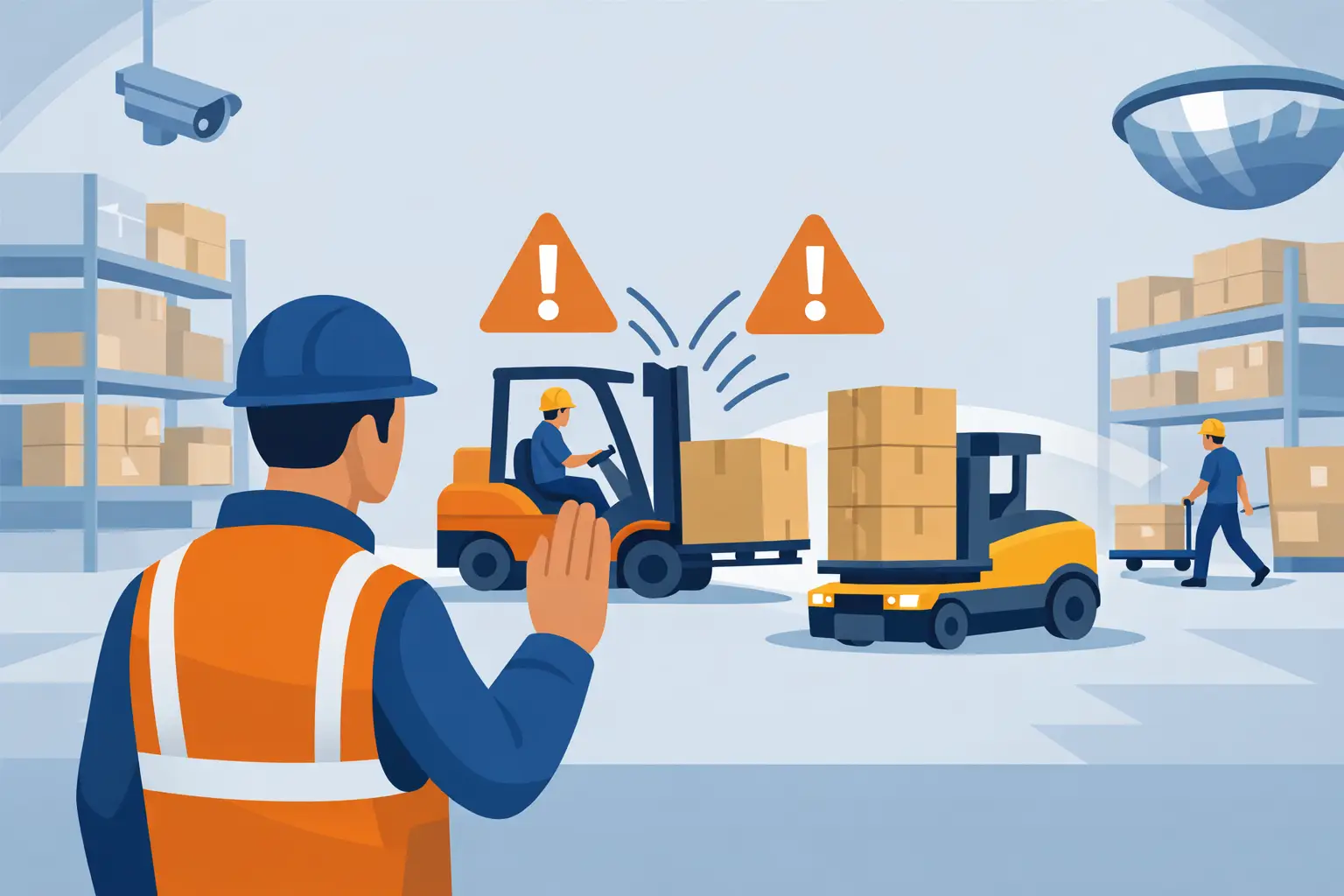
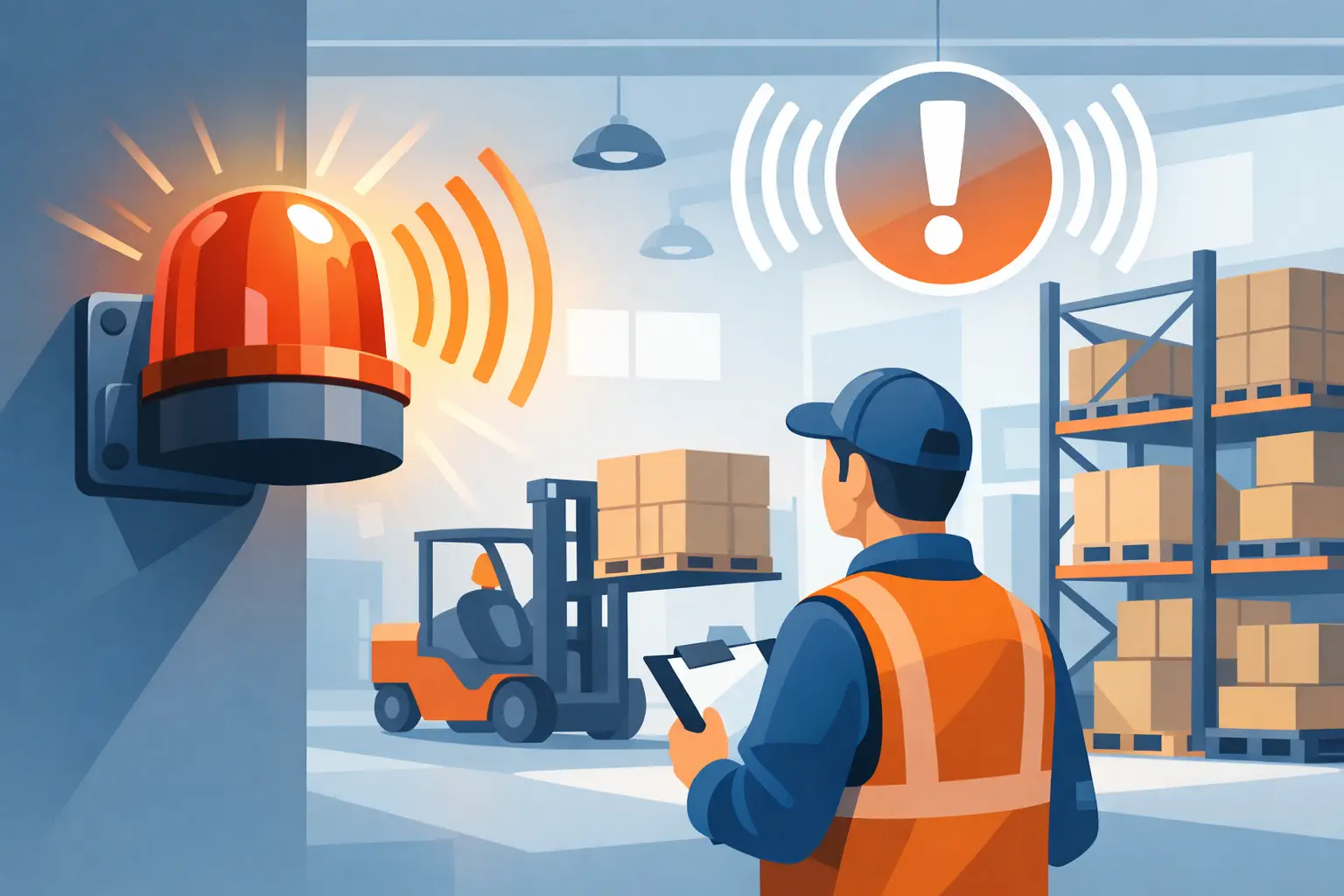
A near-miss in a warehouse rarely starts with a major failure. More often, it starts with a missed cue – a forklift coming around a blind corner, a pedestrian stepping into a vehicle lane, or a loading bay door opening during active movement. In these moments, an audible alarm for warehouses is not just a warning device. It is part of the control system that helps people react in time, avoid contact, and keep operations moving without injury or disruption.
Warehouses are loud, fast, and full of competing signals. Reverse beepers, horn blasts, conveyor noise, dock activity, radios, and human traffic all compete for attention. That is why selecting an alarm cannot be treated as a box-checking exercise. The right system has to match the real risks on the floor, the acoustic conditions of the site, and the behavior you need to influence.
Why an audible alarm for warehouses matters
In material handling environments, time is measured in seconds and stopping distance matters. A warning that arrives too late, blends into background noise, or is ignored after repeated exposure does little to prevent accidents. The purpose of an alarm is to create awareness early enough for someone to make a safer decision.
That matters most in predictable high-risk zones. Intersections, blind corners, loading bays, aisle crossings, pedestrian walkways, and battery charging areas all create moments where people and equipment paths overlap. In these spaces, audible alerts support the human layer of safety. They do not replace barriers, traffic rules, lighting, or driver training, but they reinforce them when attention drops or visibility is limited.
For operations leaders, the value is broader than incident reduction. Effective alarms can help reduce vehicle hesitation, improve traffic discipline, and support a more consistent operating rhythm. Safety and productivity are not separate goals in a warehouse. When movement is clear and predictable, both improve.
What the right warehouse alarm needs to do
The best alarm is not necessarily the loudest one. In fact, excessive volume can create a different problem. If every alert sounds urgent all day long, workers tune it out. Alarm fatigue is real in industrial environments, and it weakens the very response the system is meant to trigger.
A better approach is to focus on audibility, clarity, and context. The alarm should be heard above ambient noise, but it should also sound distinct from other site signals. It should trigger at the right time, in the right place, and only when there is a reason to act. A dock door opening, a forklift entering a pedestrian crossing, or a vehicle approaching a blind corner may each require a different alert profile.
That is why system design matters. Some warehouses need fixed audible alarms tied to sensors at intersections or loading zones. Others need vehicle-mounted alerts that activate with motion, reversing, or speed changes. In many facilities, the most effective answer is layered protection – combining localized audible alerts with visual indicators, barriers, and traffic management controls.
Audible alarm for warehouses: key selection factors
Before specifying products, start with operational reality. A food distribution site with chilled zones and fast pallet movement will have different needs from a manufacturing warehouse with narrow aisles and mixed traffic. There is no single alarm setup that fits every facility.
Ambient noise and acoustic conditions
Noise levels change across a warehouse. A receiving dock may be much louder than a storage aisle. Ceiling height, wall surfaces, and open dock doors also affect how sound travels. An alarm that works well in one zone may echo, distort, or disappear in another.
This is why site assessment matters. The goal is to make the alarm recognizable without creating unnecessary noise pollution. Tone, frequency, pulse pattern, and speaker placement all affect whether a worker notices and understands the warning.
Risk points and traffic patterns
Not every location deserves the same level of control. Focus first on areas with repeated interaction between pedestrians and vehicles, limited sightlines, and higher operating speeds. If near-miss history shows recurring issues at aisle crossings or dock aprons, that is where an audible alert can have the most immediate impact.
It also helps to look at traffic behavior by shift. Some sites are relatively controlled during normal hours but become more exposed during peak dispatch windows, overtime periods, or contractor activity. Alarm logic should reflect how the facility actually operates, not how it looks on paper.
Type of trigger
The trigger determines whether the alert is useful or ignored. Motion sensors, photoelectric sensors, loop detection, door contacts, radar, and integration with vehicle systems can all be effective depending on the application.
A poorly chosen trigger can create nuisance alarms. If a warning activates too frequently without a meaningful hazard present, workers quickly stop responding. Reliable detection is as important as the sound itself.
Integration with visual safety systems
Audible warnings are stronger when they work alongside visual signals. In busy warehouses, some workers may be wearing hearing protection, focused on scanning inventory, or operating in a high-noise zone. A flashing beacon, projected safety line, or warning light can reinforce the audible message and improve response time.
This is especially important at intersections and loading bays, where multiple people may approach from different directions. Sound gets attention. Visual cues confirm where the risk is.
Common mistakes when deploying warehouse alarms
One common mistake is relying on standard vehicle reverse alarms as the main protection strategy. Reverse alarms have a role, but they are limited. In facilities with constant truck and forklift movement, workers hear them so often that they fade into the background. They are also less effective for hazards that occur during forward travel, turning, or crossing activity.
Another mistake is treating alarms as standalone devices instead of part of a broader safety design. If traffic routes are unclear, line marking is poor, or pedestrians routinely enter vehicle zones, alarms alone will not solve the problem. They work best when they support a defined traffic management plan.
Facilities also underestimate maintenance. Speakers can degrade, sensors can drift, and mounting positions can be compromised by impact, dust, vibration, or washdown conditions. A system that performed well at installation may become unreliable over time if inspection and testing are not built into site routines.
Where audible alarms deliver the most value
Blind corners are one of the strongest use cases because they combine limited visibility with constant movement. An alarm tied to vehicle or pedestrian detection can give both parties a moment to slow down before entering the shared space.
Loading bays are another high-priority area. Door movement, trailer approach, forklift entry, and pedestrian access all create layered risks. Audible alerts can warn workers when a bay becomes active, when a door opens, or when unsafe movement is detected near the dock edge.
Pedestrian crossings benefit as well, especially where people move between picking zones, offices, charging areas, and break spaces. A localized alert can reinforce right-of-way rules in a way floor markings alone often cannot.
In larger facilities, alarms can also support emergency or abnormal operating conditions, such as restricted access during maintenance, temporary route changes, or controlled zones during high-risk tasks. The key is to keep messages clear and event-specific.
A practical standard for decision-makers
If you are evaluating an audible alarm for warehouses, ask a simple question first: what unsafe interaction are we trying to prevent? That question helps avoid overbuying, under-specifying, or installing alarms in places where they add noise without reducing risk.
From there, evaluate the environment, identify the trigger, and define the expected worker response. The most effective systems are engineered around behavior. They tell the right person to stop, slow down, wait, or look up at the right moment.
This is where a consultative approach pays off. Safety technology performs best when it is matched to site layout, vehicle mix, traffic density, and operational priorities. For industrial operators, that means looking beyond the device and focusing on the complete intervention. Companies such as SysGuard build around that principle – combining hazard assessment, engineering support, installation, and long-term service so alarms function as part of a reliable prevention strategy rather than a standalone purchase.
Every warehouse has noise. Not every warehouse has a warning system people trust and respond to. When an alarm is designed for the real conditions of the site, it does more than make sound. It gives workers time, protects equipment, and helps the operation stay in control when the floor is moving fast.