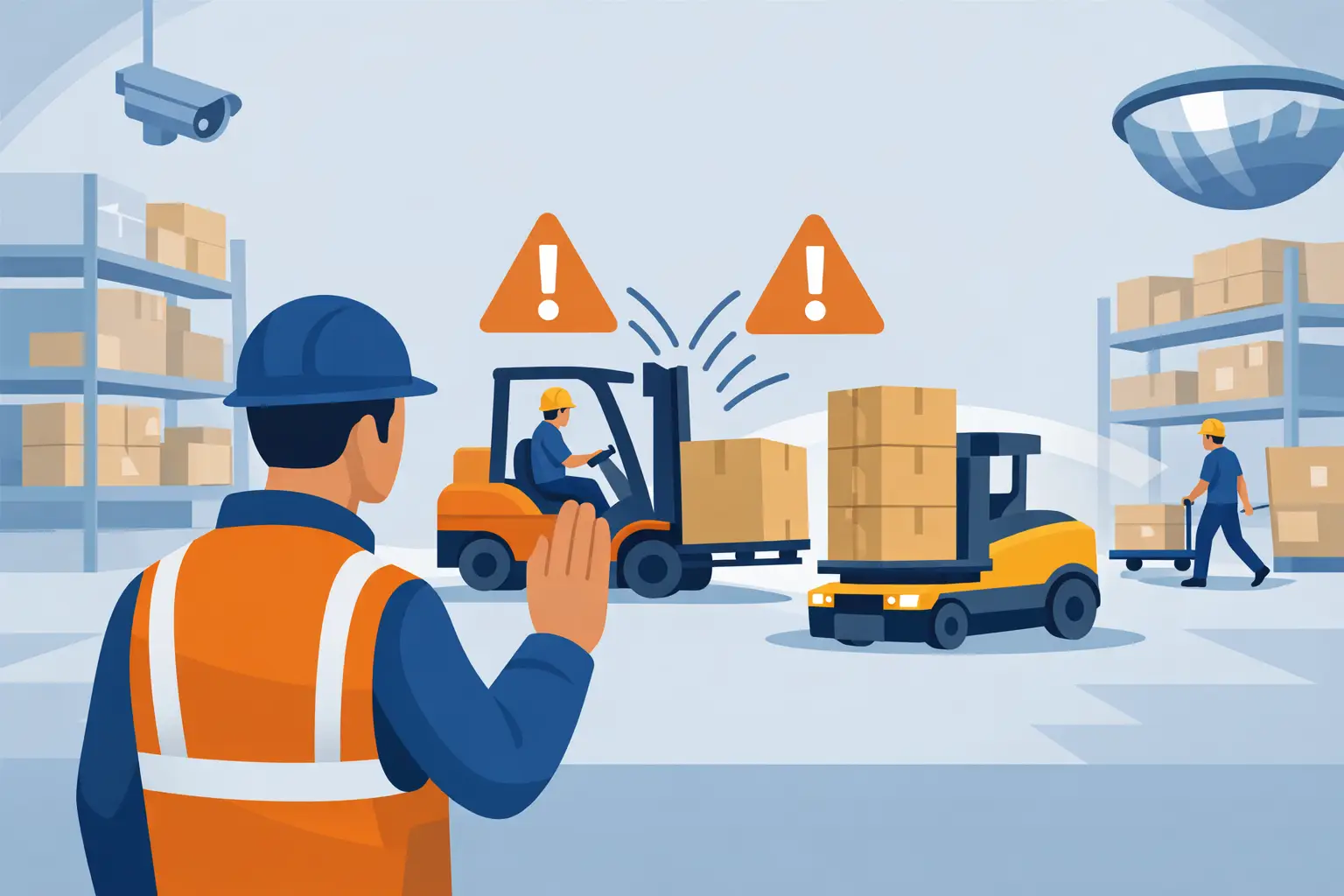

A forklift cuts across an aisle, a picker steps out from behind a rack, and a near miss lasts less than a second. In most warehouses, that is exactly how serious incidents begin – fast, routine, and easy to miss until someone gets hurt. Warehouse vision AI safety is designed for these moments. It gives operations teams a way to detect pedestrian and vehicle risk in real time, intervene early, and make busy facilities safer without slowing work to a crawl.
For warehouse managers and EHS leaders, the appeal is not novelty. It is control. Traditional safeguards such as barriers, mirrors, floor markings, lights, and SOPs still matter, but they rely heavily on constant human attention and ideal behavior. In a live facility with forklifts, pallet jacks, staging activity, and changing traffic patterns, ideal conditions rarely last all day.
What warehouse vision AI safety actually does
At its core, a vision AI safety system uses cameras and intelligent analytics to interpret what is happening in the environment. Instead of simply recording video for later review, it identifies relevant events as they happen – such as a pedestrian entering a vehicle zone, a forklift approaching a blind corner, or unsafe interaction between moving equipment and people.
That matters because a camera alone does not prevent an accident. Detection, classification, and response do. A well-designed system can trigger alerts, activate warning lights, send notifications, or feed event data into a broader safety management process. The result is practical: workers receive earlier warnings, operators have better situational awareness, and supervisors gain visibility into recurring risk patterns.
This is where many facilities see the difference between passive monitoring and active prevention. If your current setup only helps after an incident, it leaves a gap during the moment that matters most.
Why traditional controls are no longer enough
Warehouses have become denser, faster, and more variable. Throughput expectations are higher. Mixed traffic is common. Temporary labor, peak-season pressure, and reconfigured layouts can all increase exposure. Even in disciplined operations, there are limits to what signs and painted walkways can achieve.
People become familiar with their surroundings and stop noticing static warnings. Forklift operators can have obstructed views. Blind intersections remain blind. Audible alerts can fade into background noise, especially in large or high-activity environments. The issue is not whether these controls have value. They do. The issue is that they are often not enough by themselves.
Warehouse vision AI safety adds a responsive layer. It reacts to behavior and movement rather than depending only on fixed assumptions about how space should be used. That makes it especially useful in facilities where conditions change by shift, season, or product flow.
Where Vision AI has the strongest impact
Not every area in a warehouse carries the same level of risk. The strongest use cases tend to be places where visibility is limited, traffic overlaps, or reaction time is short.
Blind corners and cross-aisle intersections
These are classic near-miss zones. A forklift operator can follow procedure and still encounter a pedestrian or another vehicle with little time to respond. Vision AI can detect converging movement before line of sight is fully available and trigger local alerts at the point of risk.
Loading and staging areas
Loading bays compress vehicles, people, pallets, and deadlines into one space. During active loading or unloading, movement can become unpredictable. Vision-based detection can help identify unsafe entry into hazardous zones and support better separation between people and equipment.
Pedestrian walkways near vehicle routes
Painted lanes are useful, but they do not stop encroachment. If pedestrians regularly cross into forklift paths or operators cut too close to designated walkways, the system can flag those events and support corrective action before an injury occurs.
High-volume operating zones
Packing, replenishment, transfer, and dispatch areas often create repeated vehicle-pedestrian interaction. These are ideal places to collect data, identify behavior trends, and tighten controls based on real facility conditions rather than assumptions.
The operational case for investment
Safety leaders rarely get budget approval on principle alone. The business case needs to be clear. Vision AI supports that case because the cost of an incident goes far beyond first aid or equipment repair.
A single forklift-pedestrian accident can trigger medical costs, reporting requirements, downtime, damaged goods, internal investigations, morale issues, and reputation risk. Even frequent near misses carry a cost because they signal unstable control over the work environment. When near misses are common, serious incidents become a matter of probability.
Warehouse vision AI safety helps reduce that exposure in two ways. First, it improves immediate incident prevention through real-time detection and alerts. Second, it creates usable data. Facilities can see where unsafe interactions cluster, what times of day carry the highest risk, and whether interventions actually improve behavior.
That makes safety spending easier to defend. It shifts the conversation from reactive compliance to measurable risk reduction and operational resilience.
What to evaluate before deployment
A vision AI system is only as effective as its fit with the site. Buyers should look past marketing claims and focus on operational reality.
Detection quality matters more than feature count. The system needs to distinguish between meaningful hazards and routine movement, otherwise teams get flooded with nuisance alerts and confidence drops quickly. Camera placement is also critical. Poor coverage creates blind spots, while excessive coverage may add cost without improving protection.
Response strategy deserves equal attention. Not every risk event should trigger the same action. In some zones, a local audible and visual alert may be enough. In others, integration with warning beacons, speed control measures, or supervisory notification may be more appropriate. The right setup depends on traffic volume, layout, and hazard severity.
Facilities should also consider environment and maintainability. Lighting conditions, dust, ceiling height, rack configuration, and traffic density all affect performance. Industrial sites need systems that can operate reliably under everyday warehouse conditions, not just in clean demo environments.
Warehouse vision AI safety works best with layered protection
Vision AI should not be treated as a standalone fix. The strongest results come when it is part of a broader safety strategy built around separation, visibility, awareness, and disciplined site control.
Physical barriers still play a central role where people and vehicles must be kept apart. Rack protection still prevents structural damage in impact-prone areas. Audible and visual alerts still help reinforce immediate hazards. Training and traffic rules still define expected behavior. Vision AI strengthens these controls by making them more responsive and more measurable.
That layered approach is important because risk is rarely caused by one failure. Incidents usually happen when several small gaps line up at the same time – limited sightlines, operator distraction, walkway encroachment, rushed movement, and no active warning at the point of conflict. Technology that detects these patterns early can break that chain.
Common concerns and the real trade-offs
Some operations teams worry that AI-based systems will be complicated to deploy or difficult for workers to trust. Others assume they are only suitable for highly automated facilities. In practice, the fit depends less on warehouse size and more on risk profile.
A mid-sized facility with repeated forklift-pedestrian interaction may benefit more than a larger site with well-separated flows. On the other hand, a facility with poor layout discipline may need basic traffic redesign before advanced detection can deliver full value. It depends on whether the site is ready to act on what the system reveals.
There is also a trade-off between speed and refinement. A fast deployment in one hotspot can prove value quickly, but full-site coverage may require more planning, engineering review, and staged implementation. That is not a weakness. It is often the right way to reduce risk without disrupting operations.
This is where implementation experience matters. A consultative safety partner can assess the site, identify the highest-risk interaction points, and build a solution around the actual workflow rather than a generic product template. For industrial operators, that practical engineering approach often determines whether a system gets used well or ignored after installation.
From monitoring hazards to preventing them
The real promise of warehouse vision AI safety is not better footage. It is faster intervention and better decisions. When facilities can detect exposure in real time and learn from repeated risk events, they move from reacting to accidents toward preventing them.
That shift matters for more than compliance. It protects workers, preserves equipment, reduces disruption, and helps operations run with greater confidence. Every worker deserves to return home safely every day, and every facility deserves safety systems that work in the conditions it actually faces. The best technology earns its place by doing both.