A loading dock can go from routine to critical in seconds. One trailer creeps forward, a forklift crosses a gap plate at the wrong moment, or a pedestrian steps into a blind zone, and the cost is no longer just damage to goods. It becomes injury, downtime, liability, and a shaken operation. That is why the best loading dock safety solutions are not just add-ons. They are part of how disciplined facilities protect people, equipment, and continuity.
For warehouse managers, EHS leaders, and operations teams, the challenge is rarely a single hazard. Most incidents happen when several risks overlap – trailer movement, poor communication, limited visibility, impact exposure, and inconsistent process control. The right answer is a layered safety approach that addresses the dock as a system, not a collection of isolated products.
What makes the best loading dock safety solutions effective
The strongest dock safety programs do three things well. They physically prevent predictable hazards, they make unsafe conditions visible, and they reduce dependence on human memory alone.
That matters because loading docks are high-pressure environments. Trucks arrive off schedule. Shift changes create handoff gaps. Temporary staff may not know site rules. Even experienced forklift operators can make mistakes when visibility is poor or turnaround pressure rises. A solution is only effective if it still works under real operating conditions.
In practice, the best-performing systems combine engineered controls with clear status communication. Physical restraints, barriers, sensors, and warning devices do more than support compliance. They create a safer operating rhythm that teams can trust every day.
1. Vehicle restraint systems that control trailer creep and premature departure
If there is one safety investment that often has the fastest impact at the dock, it is a reliable vehicle restraint system. Trailer creep and unexpected truck departure remain two of the most serious loading dock hazards. When a trailer moves away from the building during loading, forklifts can fall through the gap, causing severe injury and major equipment damage.
A restraint system secures the trailer in place while loading and unloading are in progress. This creates a controlled interface between truck and dock. It also gives operators confidence that the trailer position is being actively managed rather than assumed.
Not every site needs the same restraint type. Trailer fleets, dock geometry, and carrier mix all matter. Some facilities handle a wide variety of trailer designs and need more adaptable restraint methods. Others need systems that integrate with communication lights and dock controls. The right choice depends on traffic profile and equipment compatibility, not just budget.
2. Dock light communication systems that remove ambiguity
Many dock incidents begin with a simple misunderstanding. A driver assumes loading is complete. A forklift operator assumes the trailer is secured. A supervisor believes the bay is clear when a pedestrian is still nearby. Visual communication systems reduce that uncertainty.
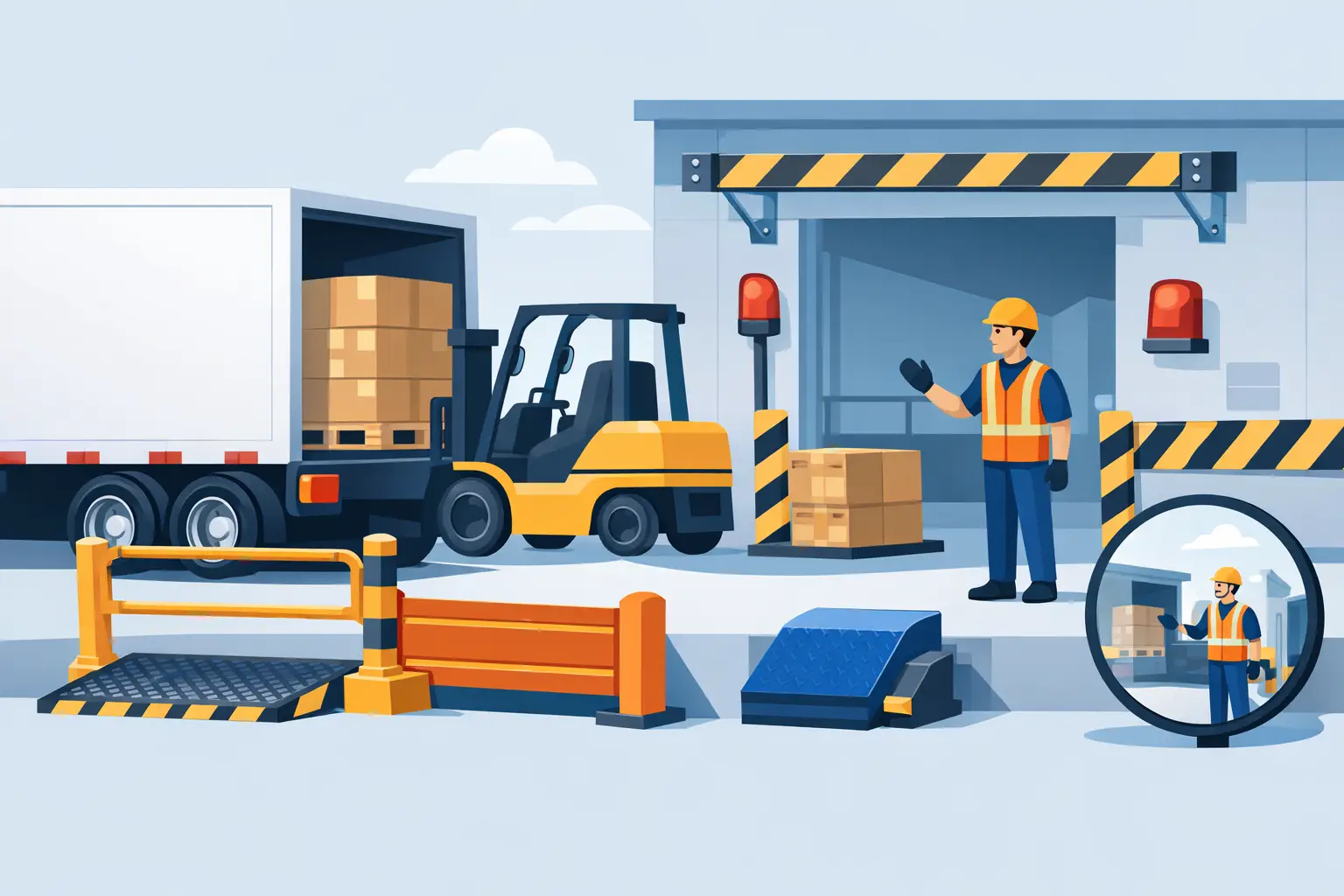
Red and green dock lights, both inside and outside the building, create a shared signal language for drivers and warehouse teams. When tied to restraints or dock position controls, these lights can indicate whether it is safe to approach, secure, load, or depart.
This may sound basic, but clarity is a serious control measure in fast-moving environments. The best loading dock safety solutions often succeed because they make the safe action obvious at the exact moment a decision is being made. In busy facilities, that kind of immediate guidance can prevent avoidable errors.
3. Dock barriers and impact protection for open edges and traffic zones
Open dock doors and exposed platform edges create a direct fall hazard for pedestrians, forklifts, and pallet jacks. At the same time, loading zones are vulnerable to repeated impact from vehicles and handling equipment. Without protection, facilities face both injury risk and infrastructure damage.
Industrial dock barriers help secure open edges when a trailer is not present. In areas with internal traffic exposure, barriers also separate pedestrians from moving equipment and protect walls, doors, and structural elements from collision.
The trade-off is that barriers must fit workflow. If they are difficult to operate or poorly positioned, teams may bypass them. That is why engineered placement matters as much as product strength. A barrier should support the way the dock actually runs, not interfere with it.
4. Wheel chocks and dock approach controls for basic but necessary protection
Some facilities overlook wheel chocks because they are seen as low-tech. That is a mistake. While chocks alone are not always enough for higher-risk operations, they still play an important role in many loading environments, especially where vehicle restraint systems are not yet in place or where site conditions require additional backup controls.
Approach-level controls such as chocks, signage, stop indicators, and designated staging lines help organize vehicle movement before loading even begins. They reduce the chance of poor trailer positioning, uncontrolled roll, and unsafe driver behavior on arrival.
That said, chocks are highly dependent on consistent human use. If a site has frequent noncompliance, wet conditions, sloped approaches, or high trailer turnover, a more active restraint solution is usually the better long-term choice. This is a good example of where safety decisions should be based on exposure, not habit.
5. Audible and visual alerts for blind spots and active movement
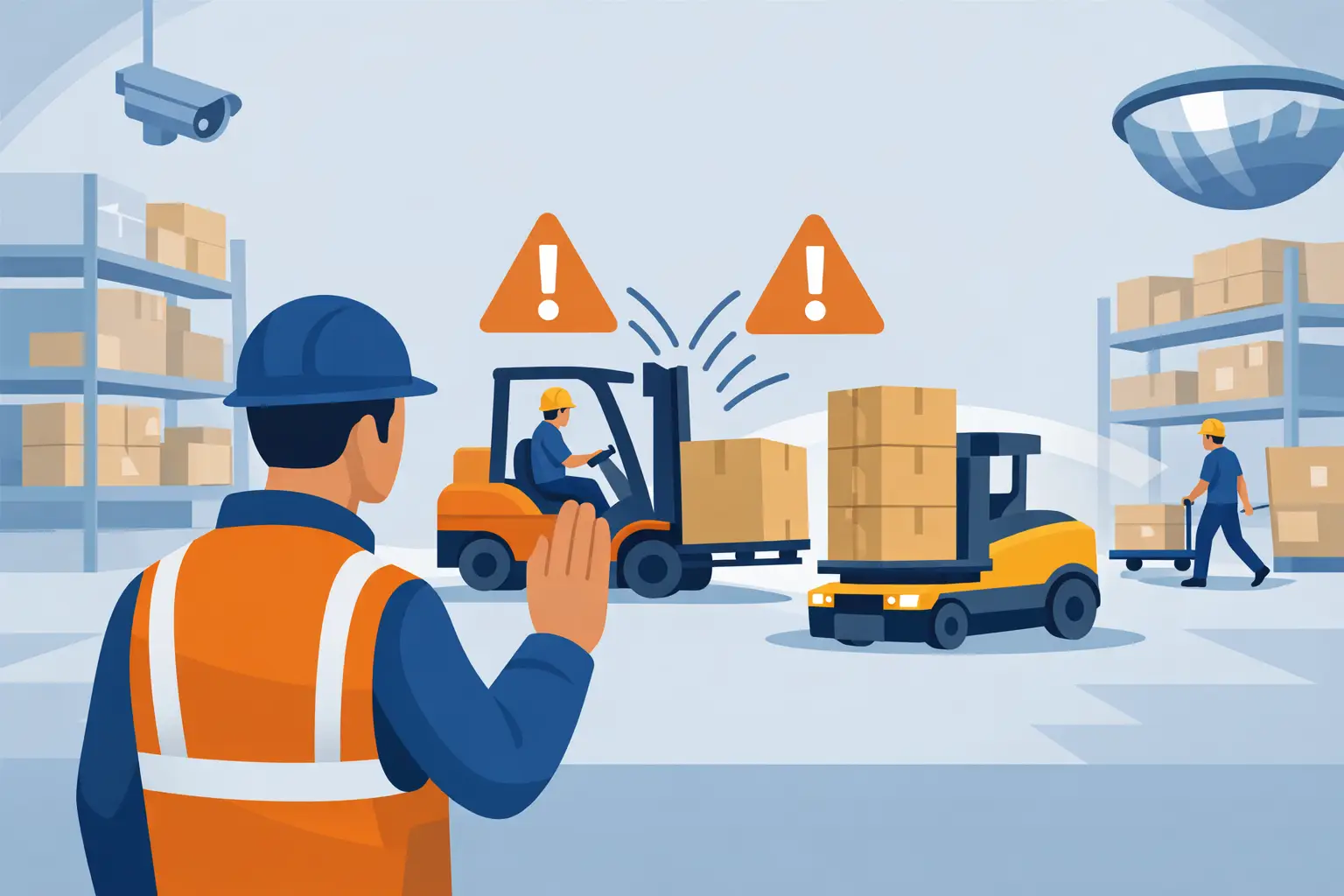
Loading docks are noisy, visually cluttered spaces. Drivers, forklift operators, and pedestrians are often working with limited lines of sight. Audible and visual alert systems help bridge that gap by drawing attention to movement, restricted areas, or changing dock conditions.
These systems can be used to signal trailer arrival, dock door activity, forklift approach, or pedestrian entry into risk zones. In some facilities, projected warning lights on the floor are particularly effective because they place the alert exactly where people are looking and moving.
The value here is not just hazard notification. It is timing. A good alert system gives workers enough warning to react before they enter the danger point. For operations with frequent cross-traffic or poor visibility around dock corners, this can make a measurable difference.
6. Vision AI and sensor-based monitoring for higher-risk docks
For facilities with heavy traffic, complex loading patterns, or recurring near misses, sensor-based safety systems add another layer of protection. Vision AI and smart detection technologies can monitor defined danger zones, identify unsafe movement, and trigger alerts in real time.
This is especially useful where traditional controls depend too much on continuous human attention. A camera or sensor does not get distracted during peak shift activity. It can support enforcement of exclusion zones, detect unauthorized access, or identify interactions between forklifts and pedestrians that need intervention.
This does not replace physical guarding or disciplined process. It strengthens them. The best application is usually in high-exposure operations where managers need both prevention and visibility into behavior patterns. When used well, these systems help safety leaders move from reacting to incidents to correcting risk before an injury occurs.
7. Integrated dock safety controls that connect the whole process
The most effective facilities do not treat dock safety as separate devices installed over time. They connect restraints, lights, doors, barriers, and alerts into a coordinated operating sequence. This approach reduces the chance that one missed step will expose the entire loading activity.
For example, a dock door may only open once a trailer is secured. Interior and exterior lights may change status based on restraint engagement. Audible alerts may activate if movement is detected during loading. These interlocks create process discipline without relying solely on verbal checks.
This is where engineering support matters. An integrated system has to reflect actual dock behavior, equipment compatibility, maintenance realities, and user training. If integration is poorly planned, the result can be nuisance alarms or workarounds. If it is properly designed, it becomes a practical control layer that supports safer, faster operations.
How to choose the best loading dock safety solutions for your facility
There is no single package that fits every loading dock. A distribution center with constant trailer rotation has different risks than a manufacturing site with fewer bays but more complex internal traffic. Start with exposure: trailer types, traffic density, pedestrian proximity, history of impact, visibility constraints, and driver compliance.
Then look at failure points in your current process. Are trucks leaving too early? Are operators entering trailers before securement is confirmed? Are open dock doors left unprotected between loads? Are near misses happening at the bay approach or inside the dock area? Good safety planning starts where control breaks down in real life.
It is also worth considering serviceability. Safety systems only protect the operation if they remain functional and trusted. Durable equipment, proper installation, and ongoing maintenance support are part of the solution, not afterthoughts. That consultative, engineering-led approach is where providers like SysGuard bring the most value, especially for multi-risk industrial environments that need systems to perform consistently over time.
A safer loading dock is not built on one product decision. It is built on a clear view of risk and the discipline to control it with the right mix of physical protection, communication, and intelligent monitoring. Every worker deserves to return home safely every day, and every facility deserves safety systems that hold up when the dock gets busy.