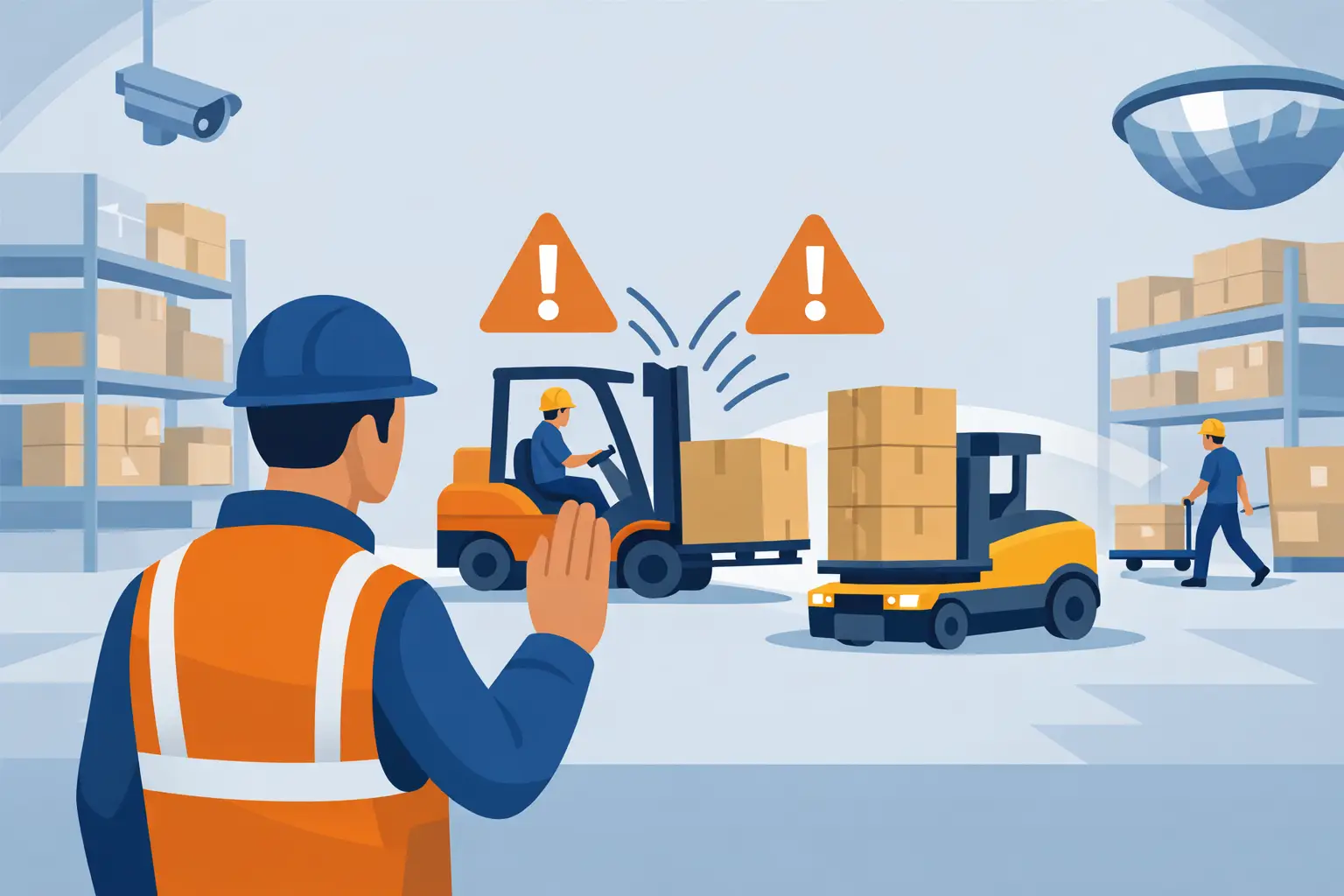
A near miss in a warehouse rarely stays a near miss forever. When forklifts, pedestrians, racking, blind corners, and loading zones compete for the same space, the margin for error gets very small. That is why forklift collision avoidance technology has become a practical safety control for facilities that need to reduce incident risk without slowing down operations.
For warehouse managers and EHS leaders, the question is no longer whether forklift risk exists. It is how to control it in a way that works under real production pressure. Mirrors, floor markings, and operator training still matter, but they depend heavily on human attention. In a fast-moving facility, attention drops, visibility changes, and habits drift. Technology adds another layer of protection when conditions are not perfect.
What forklift collision avoidance technology actually does
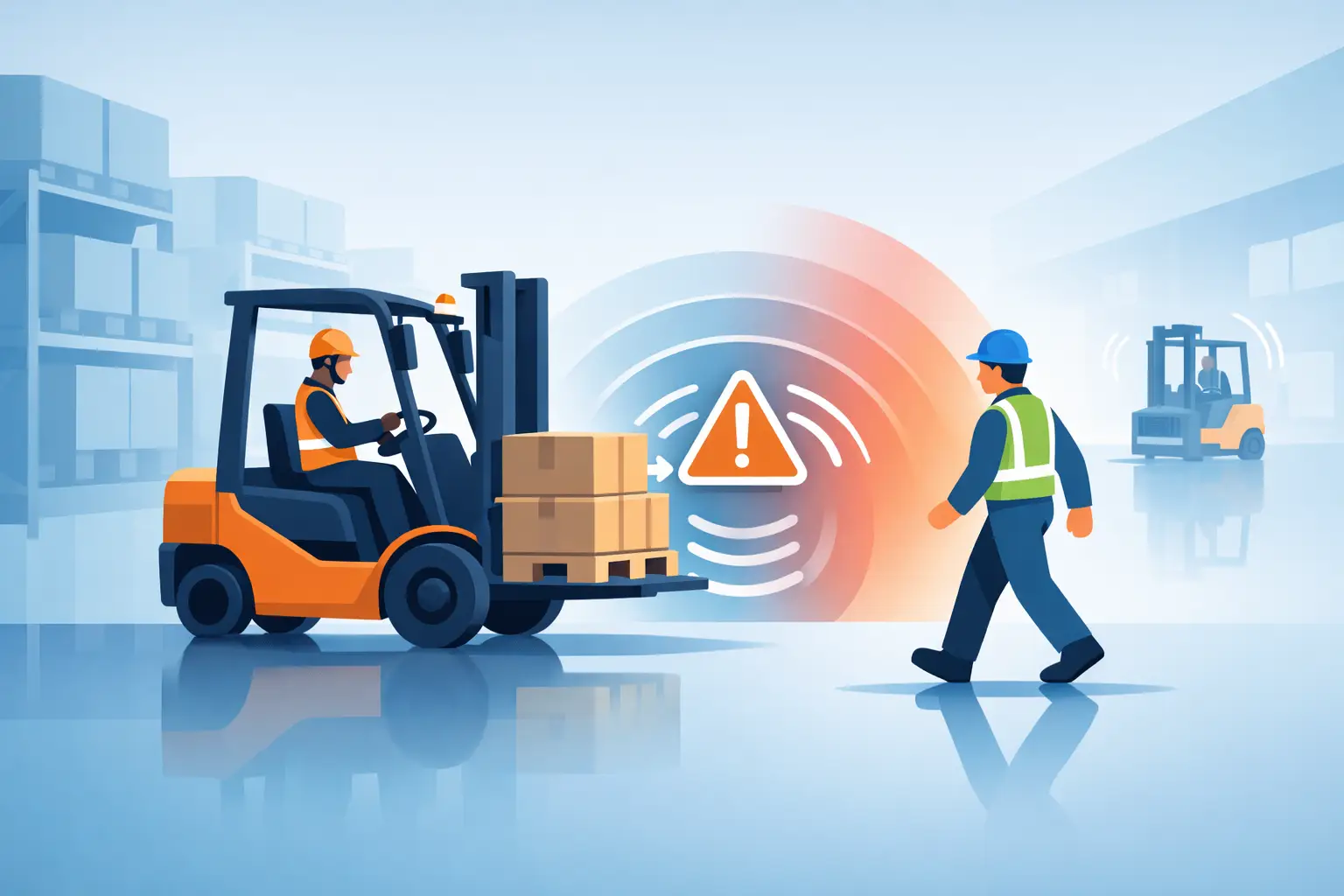
At its core, forklift collision avoidance technology is designed to detect risk early enough to warn people, influence driver behavior, or trigger a protective response. Depending on the system, that can mean detecting pedestrians near a moving forklift, identifying another vehicle approaching an intersection, reducing impact speeds in high-risk zones, or alerting workers when a truck enters a blind spot.
The term covers a range of tools rather than one single product. Some systems use proximity sensors mounted on forklifts or infrastructure. Others rely on tags worn by pedestrians, vehicle-to-vehicle detection, zone-based warning systems, visual signals, or AI-enabled camera systems that can distinguish between people, vehicles, and objects. The best fit depends on the site layout, traffic density, and the type of incidents a facility is trying to prevent.
This matters because not every forklift incident happens for the same reason. In one warehouse, the main risk may be pedestrians stepping into shared travel lanes. In another, the recurring problem may be forklifts approaching cross aisles too quickly. A plant with mixed traffic may need a wider safety strategy than a narrow-aisle distribution center. The technology should match the exposure, not the other way around.
Why traditional controls are not enough on their own
Most industrial sites already have basic controls in place. They post speed limits, mark walkways, train operators, and separate traffic where possible. Those are necessary controls, but they are not fail-safe.
A painted line does not stop a distracted pedestrian. A convex mirror does not help if the angle is poor, the mirror is dirty, or the operator is focused on a load. A warning sign loses force when people see it every day. Training is essential, but even experienced operators can make errors when visibility is blocked, shift pressure is high, or aisles are crowded.
That is where technology changes the safety equation. It provides active detection and real-time alerts in moments when human judgment may be delayed. In many facilities, that extra second of warning is the difference between a controlled stop and a serious injury.
There is also a business reality behind the safety case. A forklift collision does not only affect the people involved. It can damage racking, products, dock equipment, and building infrastructure. It can stop a lane, shut down an area, trigger investigations, and create avoidable downtime. Preventing one major incident can justify the investment faster than many teams expect.
The main types of forklift collision avoidance technology
Proximity-based systems are often the first category companies consider. These use sensors or wireless signals to detect when forklifts and pedestrians, or two forklifts, come within a defined range. The system then issues an audible alarm, a flashing visual signal, or both. Their strength is simplicity. They are useful in high-traffic areas where repeated interactions create constant exposure.
Pedestrian detection systems go a step further by focusing specifically on worker protection. Some require workers to carry or wear a tag, while others use camera-based intelligence to identify a person without wearables. Tag-based systems can be highly effective in controlled environments, but they rely on consistent compliance. Camera-based systems reduce that dependency, though performance can vary based on lighting, dust, occlusion, and site complexity.
Zone control solutions are effective for fixed high-risk areas such as intersections, loading docks, doorways, and blind corners. These systems monitor entry into a zone and activate warning lights, projected signals, or alarms when a vehicle approaches. They are often a strong choice when incident patterns are location-specific rather than site-wide.
Vehicle speed control and access control technologies also play an important role. Some facilities use systems that automatically reduce forklift speed in pedestrian zones or restrict access to certain areas. This is especially valuable where visibility is poor or where the consequence of impact is high, such as near dock edges or production lines.
Vision AI systems are gaining attention because they can add more context to detection. Rather than only sensing proximity, they can interpret what is happening in a scene and identify risky interactions. That creates opportunities for smarter alerts and better incident analysis. The trade-off is that AI-based systems require careful deployment, calibration, and support to perform reliably in industrial conditions.
How to evaluate the right system for your facility
The most effective buying process starts with incident patterns, not product features. Look at where near misses happen, what types of interactions are common, and which risks are hardest to control with procedures alone. A site with frequent blind-corner events may benefit more from zone alerts than from broad forklift-mounted detection. A large warehouse with mixed pedestrian traffic may need a layered approach.
It is also important to assess environmental conditions. Lighting, dust, aisle width, rack height, reflective surfaces, and traffic flow all affect system performance. A technology that tests well in a clean demo area may behave differently in a busy facility with shifting loads and uneven sightlines. Industrial buyers should expect a real site assessment, not a one-size-fits-all recommendation.
Integration is another practical factor. The best safety system is the one operators and supervisors will actually use. Alerts must be clear without becoming background noise. Hardware must be durable enough for industrial wear. Maintenance requirements should be manageable. If a system creates constant nuisance alarms, people will start to ignore it, and the safety value drops quickly.
Support matters as much as specification. Installation quality, commissioning, training, tuning, and after-sales service all influence results. Safety technology is not just a device purchase. It is an operational control that needs to work reliably over time.
What good implementation looks like
Strong implementation usually begins with a risk assessment and a clear scope. That means identifying priority zones, traffic types, operating hours, and the behaviors the system is meant to change. From there, the facility can pilot the technology in a defined area before expanding across the site.
A pilot is useful because it shows how the system performs under actual traffic conditions. It also helps teams calibrate alert distances, warning methods, and user responses. Some sites need louder alarms. Others need more visual cues because ambient noise is already high. It depends on the operating environment.
Training should cover more than basic use. Operators and pedestrians need to understand what the alerts mean, what action is expected, and where the system does and does not apply. Technology should support safe behavior, not replace responsibility. The strongest programs make that clear from the start.
Performance should then be reviewed using practical measures such as near misses, speed compliance, high-risk zone activity, and damage incidents. When facilities treat collision avoidance as part of continuous improvement, they get better results than when they install it and move on.
Forklift collision avoidance technology works best as part of a wider safety system
No single technology eliminates forklift risk. Facilities get the best outcomes when collision avoidance is combined with traffic management, physical segregation, warning systems, operator training, and protective infrastructure. Barriers, rack protection, dock safety controls, and visual alerts all have a role to play.
This layered approach is especially important in sites with changing layouts, temporary labor, or seasonal volume spikes. When operating conditions shift, risk often rises before procedures catch up. A well-designed safety system creates multiple opportunities to prevent harm.
That is why many industrial organizations now view forklift collision avoidance technology as an operational investment, not just a compliance measure. It protects workers, preserves equipment, and helps keep the facility running when pressure is highest. For companies serious about reducing preventable incidents, the goal is simple: give people more than one chance to stay safe. Every worker deserves that margin.