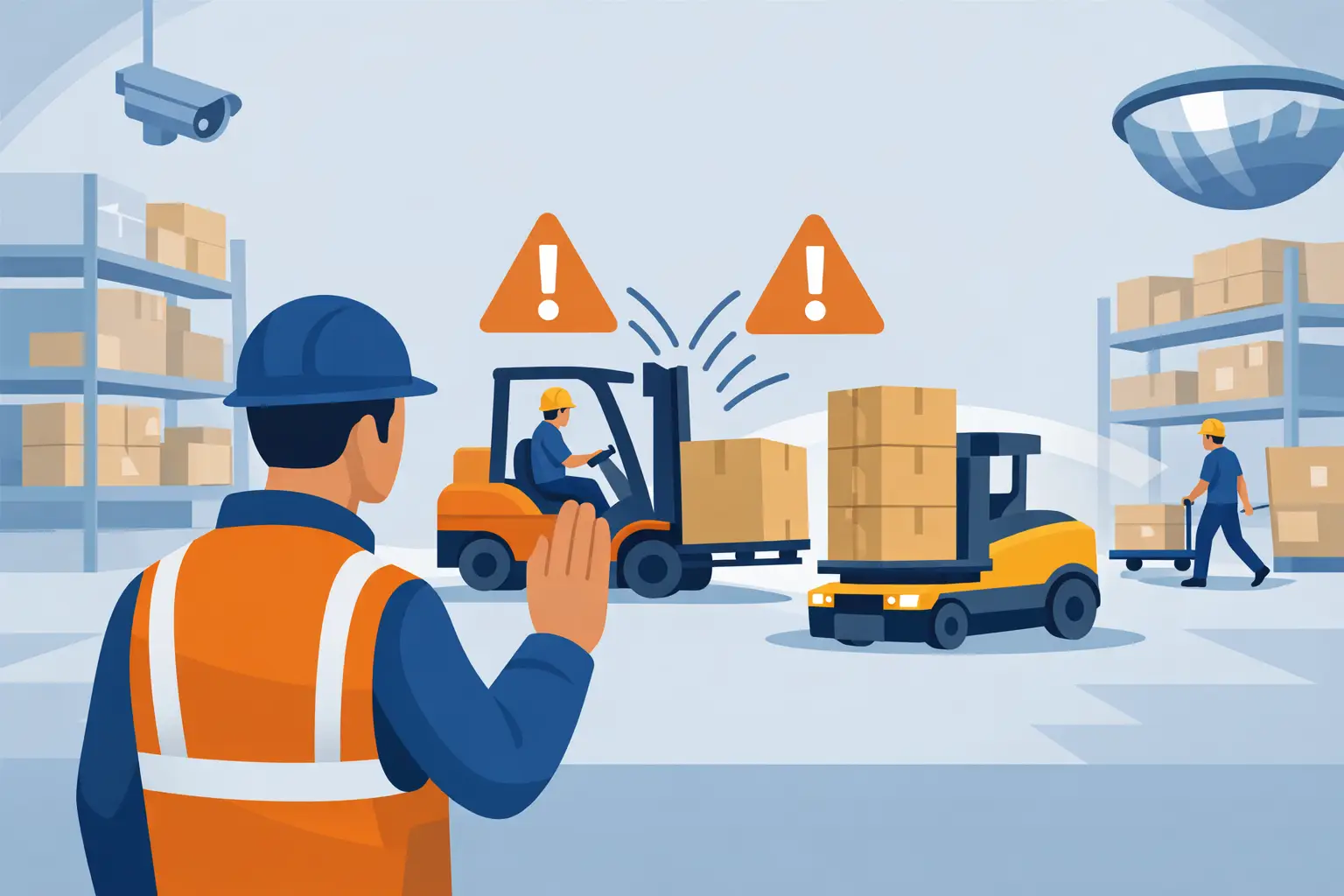
A near miss at a warehouse intersection rarely looks dramatic. A picker steps out from behind racking, a forklift rounds the corner with a load that blocks forward visibility, and both stop just in time. No injury. No damage. Operations continue. But that moment tells you something important – your site is relying too much on human reaction and not enough on engineered warning control.
A pedestrian warning system warehouse strategy is built for exactly this problem. It gives workers and drivers earlier notice of conflict points, supports safer travel paths, and reduces the chance that one brief lapse in visibility, attention, or speed turns into an incident. In active facilities where forklifts, reach trucks, pallet jacks, and people all share space, warning systems are not an add-on. They are part of how safe operations are sustained.
What a pedestrian warning system in a warehouse actually does
At its core, a pedestrian warning system in a warehouse alerts people before a vehicle-pedestrian interaction becomes dangerous. That sounds simple, but the real value is in timing and consistency. Warehouses are full of blind corners, aisle crossings, dock approaches, battery charging zones, and mixed-traffic walkways where line of sight is limited and noise levels are high.
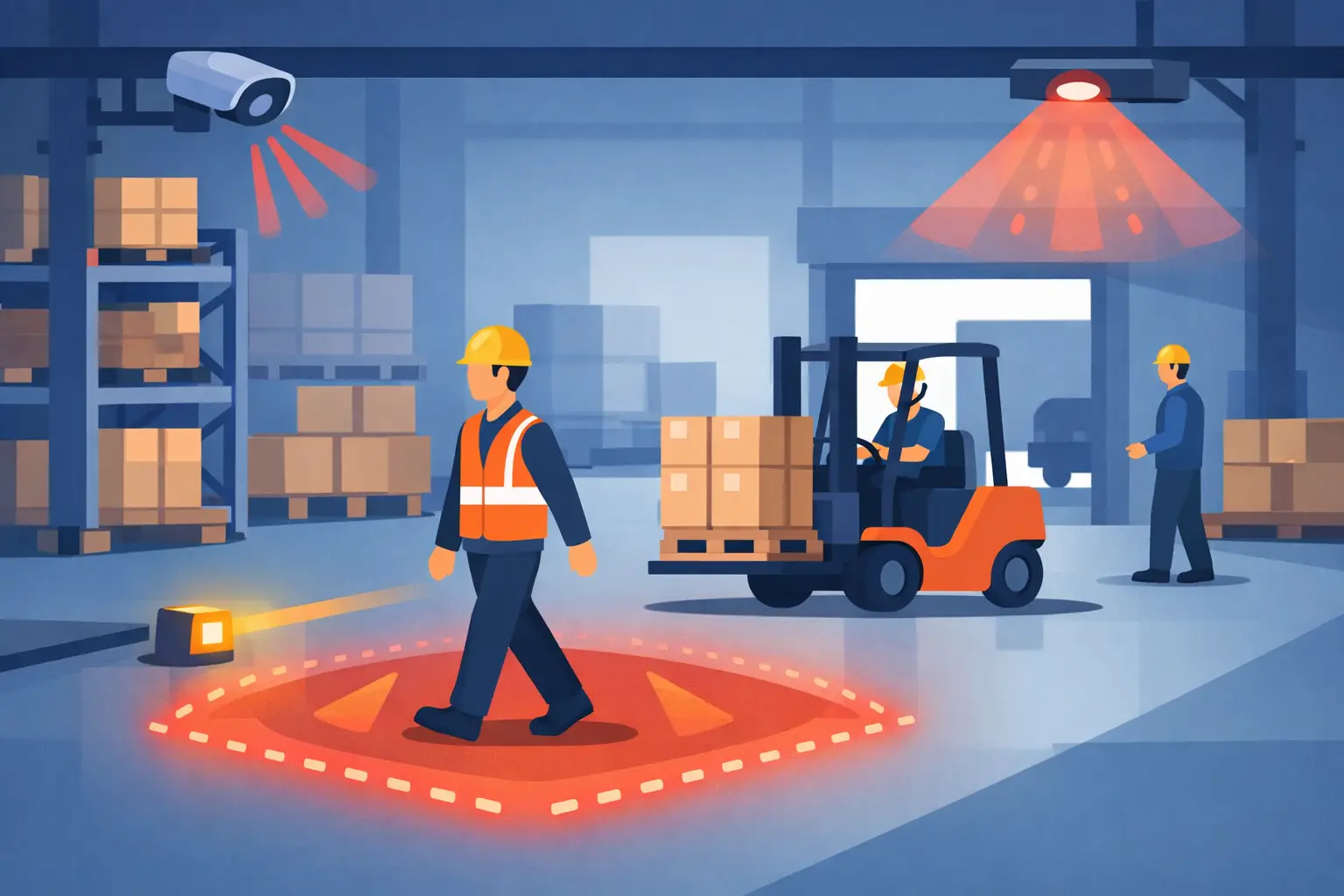
A well-designed system uses visual alerts, audible alarms, projected safety zones, sensors, signage integration, and traffic control logic to warn workers and vehicle operators at the right point of risk. Some systems activate when a forklift approaches an intersection. Others trigger when a pedestrian enters a monitored zone. More advanced setups can combine detection with speed control, access restriction, or AI-based recognition.
The goal is not to replace operator awareness or pedestrian discipline. The goal is to support both with reliable, repeatable warning signals that do not depend on perfect behavior every time.
Why warehouse traffic risk is harder than it looks
Many facilities already have floor markings, mirrors, horns, and standard safety training. Those controls matter. But in a busy operation, they are often not enough on their own.
Forklift drivers work under time pressure. Pedestrians may be focused on scanners, paperwork, handheld devices, or order accuracy. Racking creates visual barriers. Product loads change visibility from one trip to the next. Shift changes, temporary staff, and layout changes add more variability. Even a careful team can develop risk exposure when traffic density increases or workflows change faster than the safety controls around them.
This is why warning systems need to be considered in the context of actual operational behavior. A system that works well in a narrow picking aisle may not be suitable for a high-speed transfer lane. A loud alarm may be effective near docks but become background noise in production-connected zones. It depends on traffic patterns, noise levels, lighting conditions, and how often people and vehicles truly mix.
Where a pedestrian warning system warehouse setup adds the most value
The strongest results usually come from targeting the highest-risk points first rather than trying to cover everything at once. In most facilities, those points are predictable.
Blind intersections are a common starting point because they combine restricted visibility with frequent crossing movements. Dock staging areas are another priority, especially where pedestrians walk near reversing vehicles or wait near loading activity. Main travel aisles that cut across pedestrian routes also deserve attention, particularly when operators carry tall or unstable loads.
There is also a strong case for warning systems near warehouse entrances, dispatch zones, and transition areas between storage and production. These are places where workers may mentally shift tasks and become less aware of moving equipment around them. Battery rooms, maintenance access points, and temporary overflow storage zones can create less obvious risk, especially when site layouts evolve without a full redesign of traffic controls.
Choosing the right system for the risk
Not every warehouse needs the same level of technology. The right answer depends on the severity of exposure, the frequency of interactions, and the cost of failure.
For some facilities, a combination of motion-activated warning lights and audible alerts at intersections is a practical first step. These systems are relatively straightforward and can quickly improve awareness where people and forklifts cross paths.
In higher-risk operations, sensor-based solutions offer more precise activation. They can detect vehicle approach, pedestrian presence, or both, helping reduce false alarms that workers may otherwise start to ignore. Blue or red safety spotlights projected from forklifts can also help by giving pedestrians an earlier visual cue, though they work best as part of a broader control plan rather than as a standalone fix.
In more complex environments, Vision AI systems can add another layer of intelligence. These solutions can distinguish people, vehicles, and movement patterns, making alerts more relevant to actual risk. That said, advanced systems require careful planning. Camera placement, lighting conditions, maintenance routines, and system calibration all affect performance. More technology is not always better if the site is not ready to support it properly.
Good warning systems are designed, not just installed
One of the most common mistakes is treating a pedestrian warning system as a product purchase rather than a site safety control. Devices alone do not solve traffic risk. Performance depends on how well the system fits the layout, vehicle routes, pedestrian behavior, and operational tempo of the facility.
A proper assessment should look at near-miss history, shift patterns, travel paths, congestion points, and changes in line of sight across different load types. It should also consider how workers will respond to alerts. If signals trigger too often, people begin to tune them out. If alerts are too subtle, they may not cut through noise or visual clutter. If controls are placed without regard to workflow, teams may bypass them.
This is why engineering support matters. The most effective implementations are the ones that balance safety intent with real operating conditions. They account for durability, mounting position, environmental exposure, power availability, and the practical needs of maintenance teams.
What decision-makers should evaluate before investing
If you are selecting a pedestrian warning system warehouse solution, focus on outcomes first. Ask where the most serious vehicle-pedestrian conflicts occur, what current controls are failing to prevent, and how success will be measured after installation.
Durability is one key factor. Warehouse equipment takes abuse, and safety devices placed in traffic zones must withstand vibration, dust, impact risk, and long operating hours. Another factor is usability. Workers should understand the warning instantly without needing interpretation in the moment.
You should also evaluate integration. Some sites benefit from linking warning systems with barriers, access gates, speed reduction controls, or forklift safety technologies. Others need standalone solutions that can be deployed quickly in problem areas. Budget matters, of course, but so does lifecycle support. A lower-cost system that creates nuisance alarms, fails under site conditions, or lacks service backing may cost more over time through downtime, replacements, and poor adoption.
For many industrial operators, a consultative approach delivers better long-term value than buying isolated devices. That is especially true in multi-site operations where consistency, documentation, and maintainability matter.
Building a safer warehouse without slowing it down
Some managers worry that additional warnings will interrupt productivity. In practice, the opposite is often true when systems are chosen well. Clearer traffic signaling reduces hesitation at crossings, improves driver confidence in shared zones, and helps standardize movement through the facility.
Safety and efficiency are not competing goals in a warehouse. Uncontrolled traffic creates injuries, equipment damage, investigation time, labor disruption, and avoidable downtime. Preventing those events protects throughput just as much as it protects people.
That is where a safety partner with industrial implementation experience can make a difference. Companies like SysGuard approach pedestrian and vehicle risk as an operational system, not just a device category. The result is a solution that supports worker protection, facility resilience, and business continuity at the same time.
Every warehouse says safety comes first. The real test is whether your traffic controls reflect the risks your people face every shift. If pedestrians and forklifts are still depending on luck at blind corners and mixed-use zones, that is the place to act next.